Showing posts with label Chicago. Show all posts

Saturday, December 17, 2011

Holiday Images In Chicago--A Saturday Photo-Journal

Tonight I am taking a small holiday from writing, in order to share some photographs I shot a few weeks ago, on the day after Thanksgiving as we joined the crowds in downtown Chicago.

It feels right for me to think back on that wonderful day, to get into a Holiday spirit.

It's great fun to be in the city, especially with friends and loved ones.  That day, Mark and Jillian and I formed an invincible trio. 

We blended into the Black Friday crowds, walked to the Art Institute, had dinner together, and explored the Chicago Cultural Center (which I'll highlight in an upcoming journal entry).  We finished the evening at the Goodman Theater, with "Memphis".

I hope my visitors will enjoy these images as much as I enjoyed taking them.

Macy's, formerly Marshall Fields on State Street


A Sidewalk Puppet Theater regularly seen on the North Side


"GO DO GOOD"


Mark, Jillian and 'A Christmas Story'

The "L" and shopping crowds


Jillian, Mark, and the Wreathing of the Art Institute Lions


Promoting the Friday Night Holiday Concerts at Cloud Gate ("The Bean")--Windy City Performing Arts had a show on December 9th


The enormous human-face light mosaic in Millenium park


Ice Skating in the Park

The Goodman Theater, where "Memphis" played, taken a few hours before showtime

Monday, December 5, 2011

Windy City Performing Arts Winter Concert, A Rich and Wonderful Program


In three shows filled with heart, talent, and irrepressible mischief, the Windy City Gay Men's Chorus and Aria performed this weekend at Chicago's Senn Campus, and gave their richest, funniest, most emotional holiday show yet.  There was an eclectic mix of musical styles, several show-stopping solos, some alarmingly good showcases of individual talent, a "hot" brass-and-percussion ensemble, and a visit from a besotted special guest, whose martini-fueled, train-wreck of a number redefined raucous hilarity, and may have been the last word in drag (until, perhaps, March).


This year's program, titled "Sassy! Brassy! and Classy!", left audiences as fully satisfied as at a banquet, offering familiar dishes and exotic delicacies, spiced with effervescent staging, and topped off with sweet harmonies and strong vocal mixtures.  Director Stephen Edwards fashioned a wonderful show which, in spite of the  challenges and rigors of rehearsals, the choirs delivered nicely.


Another thing...I felt entirely safe in the comfortable surroundings of Senn Auditorium.  Mark was there all weekend, and the stage was filled with all of my friends who worked so hard to entertain us, with so much wonderful music beautifully performed.  I knew the same warmth I used to know looking at the lit-up tree in my boyhood living room, with all the other lights off, and the promise of good things...

The combined chorus kicked off with "Spirit of the Season" from "Polar Express", a lively number that  raised the house energy level, and set a tone of expectation for both the traditional and the contemporary.


The men moved right into "It's the Most Wonderful Time of the Year", a perennial classic (that we  break into occasionally when the pressures of the season become insane!)  The men's first set concluded with a beautifully harmonized, hushed version of "White Christmas", a song filled with nostalgia and hope, and still one one of the finest Oscar-winning songs ever. 


Aria took back the stage for a jazzy rendition of "The Holiday Season", at one point vocalizing without words in an amusing "ta-tee-ta" chorus.  Kay Thompson, a well-known actress, arranger, and godmother to Liza Minnelli, wrote this tune in 1963.


"Silent Night" always casts a breathless hush on an audience.  This version is one of the most exquisite I have yet heard.  Stephanie Dykes started with a strong baritone solo in German, with the combined chorus fading in for a melancholy rendition of the song.  Stephanie came back for a brief solo interlude, taking the song into a different key, before the chorus built in volume to a thrilling climax, at which it was impossible not to be moved.


The women lightened things up again with "The Holly and the Ivy" done in a calypso kind of beat, with great piano accompaniment and a fine solo by Valerie Silk Kremenak.


Then things got out of hand--in a great way.


Stephen breathlessly announced the appearance of a special guest!  While the chorus donned hats and grabbed their fur-lined music books in order to provide background vocals for this special soloist, we learned that the singer was none other than Mrs. Santa. 


In white silk elbow-length gloves, silver wig with a ridiculously small hat perched on top of his head, and a silky and flattering dress, Bill Howes, as Mrs. Santa, was wheeled out on a chaise lounge by two shirtless minions (Bill Marsland and Jason Spoor) sporting leather harnesses and hats, sucking on tootsie pops, and bringing continuous martinis to the hapless diva. 

The chorus followed their music gamely, while Mrs. Santa launched into an off-key riff that got appreciative howls of laughter from in-the-know audience members.  "O Holy Night" segued hysterically into everything from "Deck the Halls" to a wild-west version of "Sleigh Ride"; from a confused mix of "Frosty" and "Rudolph" to "Over the Rainbow"; from "Grandma Got Run Over by a Reindeer"; to Mozart's "Magic Flute", returning finally to "O Holy Night", before she was wheeled offstage. 


Howes tottered around the stage, goosing Director Edwards (who grabbed a drink himself), able to go from sublime to profane in one alcohol-riddled breath.  A singer has to be really talented to fashion a number so hilariously off-key and well-timed, and Howes really put on a show.  Even Michael Roberts, the Sign Language Interpreter,  seemed to be at a loss, remaining quietly hilarious, frantic to get it all spelled out. 

*   *   *   *


It was hard to top this, but the follow-up was terrific.  The brass section, with wordless vocalizations from Aria, performed a song I remember hearing a lot as a kid, but had almost forgotten, called "Bugler's Holiday".  (I was so happy to reconnect to this song--I felt like the guy in "Amelie" who has his long-lost treasure box returned to him; I had been trying so long to recall the name of this tune. ) I don't think it's strictly a holiday number, but it is appropriately bubbly with a great brass sound.  (Listen to a version of it here). 


The instrumentalists followed with an interlude of their own, "Sleigh Ride", which is more well-known.  Both this and "Bugler's Holiday" (above) were written by American composer Leroy Anderson, described by Oscar-winning composer John Williams  as "one of the great American masters of light orchestral music."


Aria's next, a Hanukkah Song called "We Are Lights" featured lovely solos from Anna Rose Li-Epstein and Katya Lysander, and incorporated a candle-lighting during the number. 


And, to finish the first half of the show, the chorus was led by soloist Libby Lane, who effectively belted "Judah and his Maccabees", a musical bible story of the origin of Hanukkah.  This number requires a strong, vibrant alto, and Lane gave an awesome and animated interpretation of the song. (Here's a version from the San Francisco Gay Men's Chorus, lead by Karen Hart, who wrote the song.)


Act Two was more emotional, more spiritual and even more amazing.  The Men's Chorus offered a quiet and powerful version of "Ave Dulcissima Maria", performed acapella with only a single bell as a regular punctuation, like a Gregorian chant.  This was rumored to be a troublesome, complex number for the singers, but from where I sat, it sounded perfect.  The piece was written in 2004 by Morten Lauridsen originally for the Harvard Glee Club. (Listen to Polyphony's version here).  Michael Vince, Ryan Johnson, and Anton Naess lent their beautiful voices in solos.


Aria came back for a suite of spiritual numbers, beginning with "December" in which the group's delicate voices perfectly captured the awesome solitude of a late winter afternoon, when the sky is all blue and pink from the setting sun.  The chilling soprano solos of Kim Duncan, Rafael Ramos, Beth Bellinger and Meghan Bennett gave the song a haunting quality.  "Hodie Christus Natus Est", "Gloria", and "Alleluia (from Songs of Faith)" recalled for me the brassy religious influence of the film scores of Miklos Rosza or the medieval beauty of "The Lion in Winter".  Paul Basler, who wrote "Hodie..." and "Songs of Faith", was pleased with the arrangement, as seen on YouTube!


Finally, "Pictures of a Season", a suite so wonderfully done that it almost requires its own post. I'll try to do it justice in summary.


"Pictures of a Season" was a set of familiar holiday compositions, arranged in such a way as to provide a depth of meaning, an emotional journey.

Starting with a plaintive phrase from "Do You Hear What I Hear?", which served as a refrain for the whole number, the brass and harp were effectively woven in between. There was a rousing version of "Born in Bethlehem", done as a 4-part round with hand-claps that got the crowd moving. Bobby Owens came in for a brief solo refrain of "Do You Hear", followed by another exciting number, "I Am The Lord of the Dance", fronted by lighthearted solos from Ray Lesniewski and Dan Craig. 

Before the climax of the choral piece, there was perhaps the most amazing solo work of all.  Madelyn Tan-Cohen, the always-reliable piano accompanist, was given the spotlight, and transfixed the crowd as she moved effortlessly across the entire keyboard and back again for a thunderous, delicate, amazing musical interlude.  Influences of Wyndham Hill and Debussy, hints of "Carol of the Bells", "Away in a Manger",  a bluesy version of "We Three Kings", and segments of "Noel" "Gloria in Excelsis", combined for a seamless rhapsody.  Madelyn, who quietly provides such great support for the vocals, here proved a tremendous talent in her own right. She received a well-deserved cheer from the crowd.

Finally, the chorus brought it all home, as the suite built in intensity to the full "Do You Hear", with full orchestral accompaniment and the entire choir giving it everything they had, to thunderous applause.


I hope this recounting of this very special concert will serve as a record of an event for some, a tribute to others, and an introduction to this special group to everyone else. 

In the coming weeks, I'll return to the personal stories of many of the members, the preparation for the March Broadway fund-raiser, and the road to the Gala Festival in Denver in July!  Stay tuned...


Monday, November 28, 2011

Broadway in Chicago: "Memphis" Rocks the House


2010's Tony Award-Winning Best Musical "Memphis" made a 2-week stop at Chicago's Cadillac Palace Theater, bringing enough energy and heart to warm the whole city.

This is a pulsing, joyous, "fantastical" entertainment featuring original music done in the spot-on style of 1950's rock-and-blues, covering the same period of time in the same tradition as "Hairspray" and "Jersey Boys", but tempered with a sad and ominous underside: the violent ignorance and racism of the era.  The music is raucous and tuneful, coupled with rollicking "Bandstand"-style choreography, and rapid-fire dialogue. There are laughs galore here, and heartache, too. 


It recreates a time of innocence in the music industry.  It was a time when an uneducated but good-hearted guy could rise to stardom on the radio, when "everybody wants to be black on a Saturday night", and when young rockers led the way to a segregated society.  ("Memphis" reminds us how far society may have progressed, and in the most indirect way, how corrupt and cynical the music industry has become today.)

But more than anything, "Memphis" is a lot of fun.  After seeing it you might leave the theater yearning to produce a rock and roll TV show, sing in a band, or dance with all your might.  You might also feel a bittersweet bond with a character who will work his way into your consciousness like a good friend does. 

"Memphis" is  about a happy-go-lucky young man named Huey Calhoun, who blasts his way into a job as a local radio DJ to play the "race music" he loves, which will soon become known as rock-n-roll.  As he champions this "dangerous" but liberating new sound, he starts a local tidal wave that soon will catch on all over the nation. Fast-talking, loose-limbed and naively likeable, Huey frequents a black club in a part of town normally forbidden to whites, and is taken by the formidable musical talents of the headliner named Felicia.  Completely smitten, he wins her over, and fulfills his promise to make her a star, just as his popularity begins to wane.


They become involved in a sweet yet forbidden romance.  "Memphis" reveals the almost impossible challenges of a mixed-race relationship,  and the compromises involved in becoming a success, especially to those who cling to their ideals.  

The sweet, nostalgic embrace that is Act One eventually gives way to the inevitable history of that time and place.  When acts of violence erupt suddenly, even in their stylized way, they are shocking. There is real pain on stage as a result.  The feel-good innocence of the music is shadowed by ignorance,

In Act two, Huey's descent is telegraphed in broad strokes---a liquor flask hidden in his jacket, and a general waning of energy--just as he hits his peak as a "Richard Clark"-styled TV Dance-Show host.  Here the production hits its peak too, using black-and-white TV cameras and a large screen to "broadcast" the action and the music that unfolds before us.  Huey's last hurrah, a rollicking number called "Tear Down the House", makes us his allies in rejecting the segregationist ideas of a big-time TV producer who wants to eliminate most of the black dancers on the set.  Toward the end, as Huey once more occupies a little radio studio on the less popular end of the radio dial, the stage is completely black except for his booth.  Huey's world has grown too small, and he has diminished with it.

Fortunately, he is held up once more for applause, as Felicia, now a star and engaged to another, encourages him to attend her show and take the stage with her.  And so, "Memphis" ends on a triumphant note. 


"Memphis" is loosely based on the real-life Memphis DJ Dewey Phillips (click on the link for his biography), who in the 1950's became a smash with his frantic on-air delivery and fierce support of black music. Phillips soon began to abuse amphetamines and alcohol, and met an untimely end at age 42.  An early version of "Memphis" had Huey die during the show; fortunately, the show maintained its optimistic tone.

The show is filled with a strong ensemble of dancers and singers.  Even the secondary characters who perform songs create memorable, rounded characters.  The staging and choreography are efficient and clever, and well above the bar set by typically excellent Broadway in Chicago productions.

Felicia Boswell has a terrific voice and is a marvelous actress too. She provides the dramatic chops "Memphis" needs to put across its serious message.  She is completely convincing during every stage of her development as a character. Her rendition of "Someday" is beautiful and true.  In an era when such things were still possible, this song, and Boswell's rendition, could have become a breakout single and a huge hit, a Broadway standard. 

As Huey's mama, Julie Johnson has the widest character arc, from a sheltered and limited woman who is afraid to go against racist convention, to a flamboyant stage mother, brilliant and hilarious.  Her "Change Don't Come Easy" number brought the house down. 

Last, and best, is Bryan Fenkart as Huey.  I will never forget his escalating rant in the radio studio, selling beer for a local grocery store.  From that moment on I was in love with the character.  He is both expansive, ready to explode in every scene, as well as a regular guy, just trying to do right by his mama and to love his sweetheart even though it is illegal for him to do so. (There are subtle shades for modern audiences of current marriages that are still illegal.)  Fenkart has perfected a set of mannerisms and vocal deliveries, with a high-pitched carnival-barker's voice and down-home accent.  I missed the original Broadway cast, but I cannot imagine a more perfect actor to embody the quirky and wonderful Huey Calhoun than Fenkart.

Hock-a doo!

(Photo by Paul Kolnik)

Friday, November 25, 2011

The Lions of the Chicago Art Institute


File:Art Institute of Chicago Lion Statue (2-D).jpg
For us, it will be a leisurely "Black Friday" in the city.  This afternoon, a stroll through downtown to take advantage of sunny and pleasantly mild weather.  

Along the way we'll visit the Art Institute of Chicago, to see the the famous two lions in their newly-donned holiday garb.  Tonight: the Tony-winning Broadway Musical "Memphis"!  Come back this weekend for reviews of this show, and of the new film "The Descendants".

Read on for more about the lions, and their artist, Edward L. Kemeys.


*       *       *       *       *

Two of the undisputed landmarks of the City of Chicago are the sculptured bronze lions that stand guard on either side of the main entrance at the Art Institute.  They are a favorite photographic subject of tourists, and delight children of all ages who visit the Museum for their first time, or  their hundredth.  The lions also serve as unofficial mascots for the Chicago professional sports teams when they make the championships, and can be seen wearing Chicago Bears or Blackhawks helmets in support. 


Today, the Holiday season becomes official with the ceremonial "wreathing of the lions":

Art Institute of Chicago: Wreathing of the Lions

Less well-known to Chicagoans is the sculptor who carved these lions, Edward Kemeys (1843-1907).  Kemeys was born in Savannah Georgia, and studied art in New York and Paris.  As a boy  he delighted in his visits to the prairies of Illinois, and marveled at the animals he observed at New York's Central Park Zoo.  He became famous for his uniquely Western style of art, and for his sculptures of animals. The bronze lions, completed in 1893, are his most famous.

Kemeys unofficially named the lions: the south lion is "stands in an attitude of defiance," and the north lion is "on the prowl."

Edward Kemey's lions at the Art Institute of Chicago
South Lion: "Stands in an Attitide of Defiance"


North Lion: "On the Prowl"


Among Kemeys' other works, his "Panther and Cubs" can be found outside of the Metropolitan Museum in New York seen below).  There is also a collection of Work at The National Museum of Wildlife Art in Jackson Hole, Wyoming.

Wednesday, November 16, 2011

Beyond Brokeback: A Return to The Movie That Changed Everything


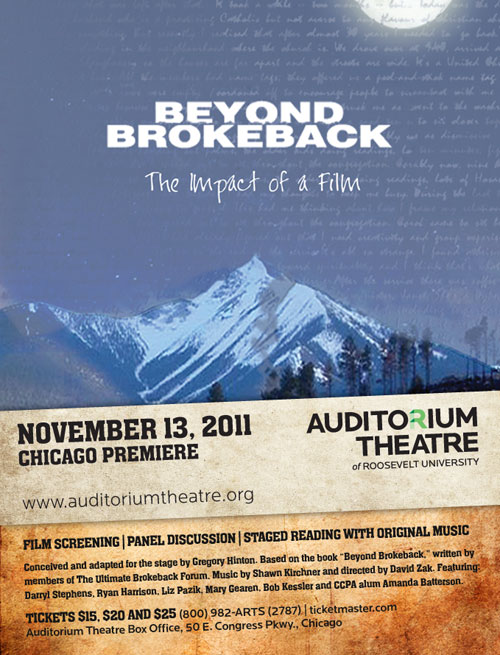
Last Sunday, Mark and I attended a special program called "Beyond Brokeback" at Chicago's Auditorium Theater.  This was a special, big-screen presentation of 2005's "Brokeback Mountain", followed by a brief panel discussion, and a performance of an original reading and music performed by members of the Ultimate Brokeback Forum.


We stumbled upon this event by accident about three weeks ago.  On a leisurely walk through our favorite Andersonville neighborhood, we dropped by the Chicago Filmmakers' storefront to check out what was new. On the entrance table crowded with information, we spotted the promotional "postcard"---an appropriate way to advertise this particular program.


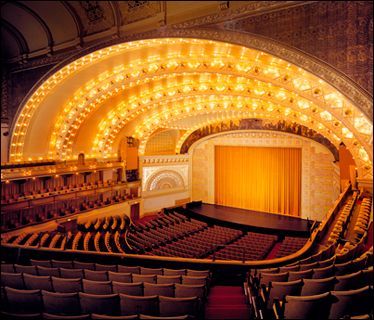
It was an awe-inspiring experience to view "Brokeback Mountain" in the surroundings of the big, historic (1889) Auditorium Theater.  It had been five years since we saw it on a big screen. The projection was crisp and the sound system was exquisite.  To see "Brokeback Mountain" in the way in which it was intended to be seen, even after having watched the film many times on suburban screens and home video, had the same gut-wrenching impact it did on my first viewing. 

*      *      *      *      *      *


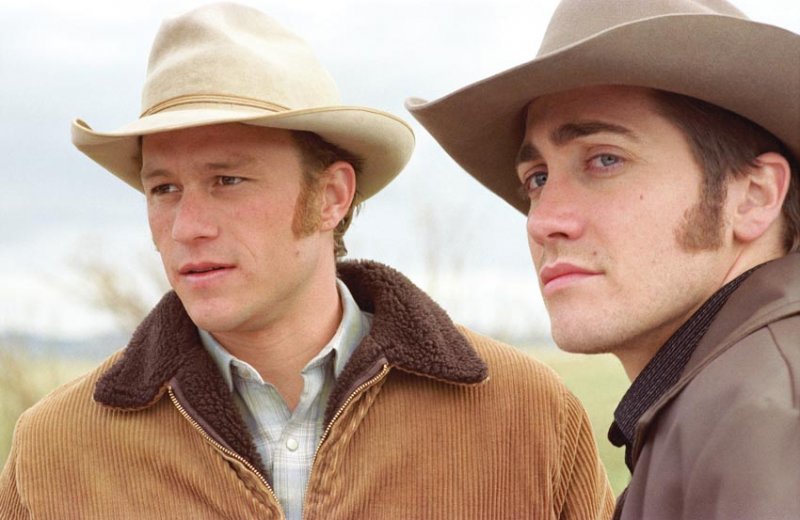
The opening thirty minutes of "Brokeback Mountain" are as perfect a work of filmmaking I have ever seen.  This idyllic sequence, removed from civilization, in which Ennis and Jack transcend their sheltered, inarticulate origins and find in each other a love they can't explain, let alone understand, stands on its own as a complete short film.  That's why the remainder of the movie, where the passing of the characters' years is as compressed as their lives, which inevitably trap and confine them, is so utterly heartbreaking. 


And then there is the pivotal scene in the tent, the focal point of all of the controversy, the hate, the satire, the fear, the held breaths, the discussion that the film inspired for months after its release.  After several years, and repeated viewings, this two-minute sequence remained for me as powerful as ever.  I was struck by the passionate violence of it, as though someone who is about to drown finally surfaces, gasping for life. 


This is the scene that changed everything for these characters, for audiences, and for Mainstream Filmmaking.  This uncontrollable, desperate sexual encounter by these fumbling, dreamy characters,  icons of American masculinity,  instictive and animal-like in its intensity, was an historic movie moment.  Try as it might, Hollywood could not deny that after this scene, nothing would ever be the same for moviegoers or filmmakers.  Hollywood instead denied the film a Best Picture Oscar, in spite of the most universal critical acclaim ever earned by a nominee that lost in that category. 


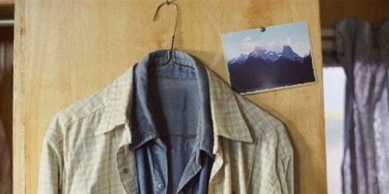
"Brokeback Mountain" is a very rare film indeed, in which every scene, every moment is necessary, each piece of music captures the emotional resonance of a sequence, each camera setup is perfect to the exact millimeter, every line reading is inevitable, essential.  Everything moves toward the eloquent final image, in which a man,  touched beyond his ability to fully contain his passion, finds his life tragically reduced to two bloodied shirts and a postcard.  His view, no longer that of a vast and beautiful wilderness filled with possibility, becomes a small glimpse at a desolate field, framed from within a murky mobile-home window.


*      *      *      *      *      *  


After the screening, with only 15 minutes to recover from a deep sense of quiet and sadness, we stayed for a panel discussion. The panel included  Jean de St. Aubin, Executive Director of the Gene Siskel Film Center;  Larry Howe, Professor of English at Roosevelt University; and Bruce Jenkins, Professor of Film, Video, and New Media at the School of the Art Institute of Chicago.  All were introduced by Dr. Chris Chulos, Chair of the History Department at Roosevelt University.


Aubin recounted some interesting history around the film's critical reception, finishing with an excerpt from Roger Ebert's original 4-star review.  Jenkins had some good insights onto the psychology and sociology of the film.  Howe was less impressive, deconstructing the film in the typically dry scholarly fashion that sucks out all of the passsion and fun one brings with them to the art of film.


I was proud of Mark, who rose for a question, and received much applause for his comments.  Mark asked why, after "Brokeback", Hollywood still finds it difficult to make more authentic gay films, or include more incidentally gay characters, instead of cloaked material full of innuendo like "J. Edgar".  The panel struggled to find an answer, retreating into titles form 20 years ago, or citing the ever-progresssive filmmakers of Europe.  At least they recalled titles like "Milk" and "The Kids are All Right", although, as good as those films are, neither has the visceral impact of Ang Lee's remarkable film.

*      *      *      *      *      *
Owing mostly to our long drive back to the suburbs, we did not stay for the staged reading, with original music.  In a way I regret having missed it; but then, after the power of the film, it would have been difficult to concentrate on another rendering of the story, or to give it the attention and emotional investment it deserved.  Maybe I will catch it again in another city, or on a return encore presentation.  Perhaps the group can be persuaded to put the performance on DVD, or post on YouTube.  Their next performance is scheduled for February in Las Vegas.  I wish them all well.

Saturday, October 22, 2011

Chicago Cubs and Hollywood: An Interesting New Connection

*
What do the Chicago Cubs now have in common with "Here's looking at you, kid",  and Brad Pitt?


This guy....


Something big is about to happen with the hapless Cubs, Chicago's beloved baseball team that nevertheless has not won a World Series for 103 years....  It should be a boon to the team, and provide a movie-lover like me a new level of interest in next year's season....


It's Saturday night, and Mark, who is a fan of the St. Louis Cardinals (the Cubs' arch-enemy), is enjoying the Cardinals' promise to triumph over the Texas Rangers in game 3 of this years' series.  So tonight, something brief, and lighthearted.


Tom Ricketts, the new owner of the Cubs Organization, is closing a deal with the Boston Red Sox to bring Theo Epstein to the Cubs as the President of Baseball Operations.  Epstein was the Golden Boy who used smarts and statistics to bring the Red Sox a 2004 World Series Championship after 83 years, and a second Series Championship 3 years later.  At 28 years old he was the youngest general manager to lead a ball team to Series victory.


I find Epstein's baseball story as fascinating as I find the man personally interestting.  I will cover him, and the Cubs, regulary an the coming Baseball Season.


ESPECIALLY INTERESTNG so far, to me and hopefully to my movie-loving readers, are these two items:


--Epstein took the job with the Red Sox when the first man who was offered the job, Billy Beane, turned it down. Beane is the subject of the new film "Moneyball", which I'll review here soon.


--Epstein's grandfather, Philip G. Epstein, and great-uncle, Julius J. Epstein, won Oscars for the screenplay of "Casablanca".


While neither of these tidbits will have anything to do with Epstein's success with the Chicago Cubs, the continuity with the past glories of 1940's movies, and the slight connection with the subject of one of this year's most highly praised films, feels right....  and gives a trip to Wrigley Field a claim to modernity and the legitimate nostalgia it deserves.


And that should do it for a Saturday night.

Tomorrow....a look at the horrific world of mental illness in "Take Shelter"