Showing posts with label Reading and Books. Show all posts

Thursday, November 17, 2011

National Book Awards 2011--Let the Award Season Begin!


It's that time again, as the literary world recognizes the best efforts of authors around the country.

The National Book Awards, (along with the Pulitzer Prizes), have held my interest for many years.   When I started reading in earnest again, after 9/11, the lists of winners and finalists from both Literary Awards helped me identify quality writing. From these, I identified favorite authors, read more of their work, which helped me branch out into other works in similar genres.

As I read more, I gained confidence in my evaluations of quality, and relied less on the award itself as anything more than a way of locating serious new work.  I began writing more, too, so I was less intimidated by the opinions of "experts".  I  thought more about what I was reading, and honed my critical skills, asserting my own opinion of a work, good or bad.

More and more each year, I am unfamiliar with some of the authors of the books that are chosen as finalists and winners. That, to me, is a good thing, because it says that publishers are accepting new work, and submitting excellent work from new voices. That gives new hope to writers like myself.  It also provides readers like myself an introduction to original writing, and is endlessly inspiring and enlightening.  I have my reading material for the winter!

Movie lovers, too, might enjoy picking out which books could have the makings of an Oscar-winning film!

The diverse and interesting subjects of this year's 5 selected works of Fiction include: an adventure set in the Italian Alps in World War One; a Balkan woman's search through "the Jungle Book" for clues to her Grandfather's death; an epic about Japanese "picture brides" in San Francisco circa 1900; classic and contemporary short stories spanning the globe and four decades; and a tale of a motherless Mississippi family's survival in the wake of Hurricane Katrina.

The cited Non-Fiction works include: a young New York Jewish woman converts to Islam and embraces her exile in Pakistan; the little-known love story between Karl Marx and Jenny von Westphalen as he works on his book Kapital; a Renaissance book hunter in 1417 locates a book by Poggio Bracciolini that predicted the existence of atoms and disputed the existence of God; a newly-researched biography that chronicled the constant re-invention of Malcolm X; and he story of Nobel-Prize scientist Marie Curie, her work, and her bittersweet marriage.

The 2011 Award page from the National Book Award web site appears below.  Match the book with its capsule description, and see which books won the prize. Click on the book cover to learn more about the book, its author, and read excerpts. (The books to the far right may be cut off...just click on the left edge!)


2011 NATIONAL BOOK AWARD FINALISTS ANNOUNCED
FICTION
2011 National Book Award Fiction Finalists The SojournThe Tiger's WifeThe Buddha in the AtticBinocular VisionSalvage the Bones
WINNER: Jesmyn Ward, Salvage the Bones
(Bloomsbury USA) - Interview coming soon.
FINALISTS:
Andrew Krivak, The Sojourn
(Bellevue Literary Press) - Interview
Téa Obreht, The Tiger's Wife
(Random House) - Interview coming soon.
Julie Otsuka, The Buddha in the Attic
(Alfred A. Knopf, an imprint of Random House) - Interview
Edith Pearlman, Binocular Vision
(Lookout Books, an imprint of the Department of Creative Writing at the University of North Carolina Wilmington) - Interview
Fiction Judges: Deirdre McNamer (Panel Chair), Jerome Charyn,
John Crowley, Victor LaValle, Yiyun Li
NONFICTION
2011 National Book Awards Nonfiction Finalists Malcolm X: A Life of Reinvention
WINNER: Stephen Greenblatt, The Swerve: How the World Became Modern
(W. W. Norton & Company) - Interview
FINALISTS:
Deborah Baker, The Convert: A Tale of Exile and Extremism
(Graywolf Press) - Interview
Mary Gabriel, Love and Capital: Karl and Jenny Marx and the Birth of a Revolution
(Little, Brown and Company) - Interview
Manning Marable, Malcolm X: A Life of Reinvention
(Viking Press, an imprint of Penguin Group USA) - Interview
Lauren Redniss, Radioactive: Marie & Pierre Curie, A Tale of Love and Fallout
(It Books, an imprint of HarperCollinsPublishers) - Interview
Nonfiction Judges: Alice Kaplan (Panel Chair), Yunte Huang,
Jill Lepore, Barbara Savage

Wednesday, October 12, 2011

An Alarming Contradiction--Job Openings Are Going Unfilled

Make the school day longer, and then cut access to a free educational opportunity?

(We'll return to the world of movies later this week.)

Chicago Mayor Rahm Emanuel caused a  furor recently by pressing legislation to lengthen the school day in Chicago Public Schools.  A typical school day had been from 9:00am-2:45pm, or 5 hours and 45 minutes. Emanuel sought to add about 90 minutes of additional instruction time per day.

Emanuel's primary concern, in an era when a well-trained workforce is crucial to a vastly changing job market, was that children would receive the additional instruction needed to prepare them for advanced study, or to qualify them for positions as skilled workers.

Then, I heard something that made me pause:

Today, Emanuel's first annual budget for the city was unveiled.  One of the many measures, proposed to close a multi-million-dollar deficit, was to shorten the hours at many Public Libraries.

That sounded to me like a mixed message.

Is Emanuel paying lip service to increased instruction and competitive education?  Why keep kids in school longer and then restrict citizens' access to materials that may help them learn and improve their lives?

As reported in the Tribune, libraries will be closed during their "least-used" hours.  But why not encourage heavier usage?  Why not turn the libraries into centers of workforce development and community education?  It makes no sense to decrease access to a center of free inquiry and self-improvement and education. 

Libraries should not be relegated to the dustbin of history.  There are a lot of materials, archived preserved, that are still useful, especially reference materials, that can still be used, to maintain a depth of knowledge, and a  more complete worldview.

I think it is dangerous to rely on the Intenet for all of one's information and instruction.  It's as absurd to think that the Internet is a reliable and objective source of all reference material, history, culture, and news, as it was assumed at one time that Television was all one needed for one's information and education.

Search engines are sponsored; search results as a result can be filtered.   Material on the internet is unfettered, much of it lacking the "antiquated" principles of accuracy and objectivity.  It's a wild frontier in many ways.

All of this feeds into my reaction to a surprising and disturbing story I have heard a lot recently, summarized well in the Huffington Post:

While 14 million people in the US are looking for work, 52 percent of U.S. employers have difficulty filling critical positions within their organizations -- up from 14 percent in 2010.

Many of the manufacturing jobs going unfilled require skills and knowledge in math and sciences.  In 1980 these disciplines accounted for 11.1 percent of college graduates. In 2009, it fell to 8.9 percent.

Older workers are retiring, and younger workers have either not applied to fill these vacancies, or else lack the proper background and training.  Many vocational training programs have been cut, or else are out of date.

We need to reinforce all opportunities to educate its citizens and potential workers, within the schools and within the community.  Make a case for extended schooldays (and, maybe, consider compensating teachers proportionately). Also, don't close a community center of free inquiry and exploration--the Public Library--but find ways to make it more active in workforce training.

American culture has to commit wholeheartedly to the idea of lifelong education, in all of its forms...and that means, not restricting access to educational materials, just to close a budget deficit.

Read the article to get an idea of the gravity of the situation in which thousands of jobs are going unfilled in this time of alarming long-term unemployment (which you can find on this link).

Monday, September 26, 2011

Mini Review: "Capote", Bennett Miller's Previous Directorial Effort


With this weekend's release of "Moneyball",  I realized with surprise that its director, Bennett Miller, had not helmed a film since "Capote" (2005).  I just watched Philip Seymour Hoffman in "Capote", mostly because "Moneyball" (which I have not yet seen) renewed my interest in Bennett Miller.  

Miller's quiet, focused technique in "Capote" seemed at odds with the fast-paced, expansive style one expects from a sports movie.  Nevertheless, "Moneyball" is a film I would like to see very soon.  In the meantime, I went back and looked at "Capote" again.

"Capote" is spellbinding, mesmerizing...even a bit austere, at times.  Miller and his screenwriter Dan Futterman (so cute as Robin Williams' son in "The Birdcage") concentrate on just four years in the life of writer Truman Capote, the creation of his famous docu-novel "In Cold Blood", and his confused and manipulative affection for killer Perry Smith.  Capote interviewed Smith (who, along with Dick Hickock,  perpetrated the tragic murder of the Clutter family in Kansas in 1959) while doing research for the book.   

Did Truman Capote ingratiate himself with Perry Smith because he identified with Smith's troubled childhood? Was Capote in love with him? Did Capote work on Smith's behalf, and delay Smith's execution, so that Smith would remain alive long enough for Capote to finish his book?  The film skillfully balances these intriguing contradictions, and the script goes deep, giving Hoffman descriptive monologues to paint a portrait of Capote's past.  Capote's well-known flamboyance, charm, and talent are shown along with his self-centeredness, his manipulation of others, and his thoughtless opportunism. 

The film needs a strong center, and Philip Seymour Hoffman brings in a performance of uncommon power, creating a portrait of Capote from the inside-out.  Hoffman seems to have diminished in stature, in what is much more than simple mimicry of Capote's eccentric speech and mannerisms.  Hoffman accomplishes the task of showing Capote's outrageousness, while constantly covering up, hiding his motives.  In his final jailhouse emotional breakdown, Hoffman makes us feel the deep regret, the sudden realization of the depth of his feeling for this killer who is about to die.


"Capote" plays like a virtual re-telling of  "In Cold Blood", but with Capote himself in front and center.  It recreates the horrible incident in the Clutter house in the same manner as "In Cold Blood", first showing the aftermath and later forming the climax of the work, and fleshes out the people and environment of that place and time. (Amusingly, Manitoba, Canada stands in for the bleak, autumnal  locations of  late '50's rural Kansas.) An interesting departure from the book is the addition of Capote's supportive long-time friend and fellow author Harper Lee, who published "To Kill A Mockingbird" while Capote researched the Clutter tragedy.  Catherine Keener plays her warmly, confidently.

Director Miller draws us in with deliberate camera movements and long takes,  and along with his skilled crew and cast (including Chris Cooper), gives us an admirable and thought-provoking work. At times, midway into the film, I would have preferred a lighter touch, and a livelier pace, but the consistency of tone ultimately works.  Seen in the perspective of six years, removed from competition for awards (2005 was a particularly unnerving and contentious award year), "Capote" has emerged as a rightful contemporary classic.

Friday, September 16, 2011

"Girls Like Us" and A Joni Inspiration


Sheila Weller's 2008 triple-biography titled "Girls Like Us" is an ambitious, successful attempt to recreate the 1970's era of social and artistic ferment, as told through the life stories of three musicians who achieved their greatest success at that time: Carole King, Carly Simon, and Joni Mitchell.

Weller's book reads like an episodic novel with three completely realized female leads.  Each of their life stories are vastly different from one another, yet complement each other.  The book alternates and weaves the three stories into a "tapestry" (pun is intended) about the creative process, the sublimation of hardship to art, and the way music reflected and influenced the changing gender roles and cultural expectations of a generation.

It is a marvelous read.  As I make progress, I hope to record my impressions, and share passages that especially stimulated and moved me.

Joni Mitchell's story is especially interesting to me.  I regard her with some reverence, for her lyrics stand alone as poetry apart from their tunes, but together they make a potent statement about love, loneliness, creativity, and the machinations and the yearnings of the heart and mind.  

I am listening to Mitchell's 1970 album "Ladies of the Canyon" as I write this, around midnight in Chicago on a cool, crisp autumn Friday evening.  This album introduced listeners to her pop classic "Big Yellow Taxi" ("....they paved paradise and put up a parking lot..."), and her anthem to a milestone event, "Woodstock", performed as a mysterious and dreamy ballad (in contrast to the classic rock-and-roll  version recorded by Crosby, Still and Nash).


Mitchell's music and poetry constantly refresh me,  put me in touch with my creative energy, amaze me with their intelligence and soul-baring emotion. 

Joni lived a life that I would love to turn into a screenplay: a small-town Canadian girl from a conservative family, who discovers her passion for music and painting, fights polio, and hits the road to sing and write music.  Alone, and pregnant, with little to sustain her but her talent, she gives her baby up for adoption, becomes an iconic member of the Laurel Canyon folk-rock scene, and earns the respect of musicians and artists through a stormy but brilliant career.  As her voice mellows and matures, her music takes more chances, and her art and talent find new adherents.  Eventually, dramatically, she is reunited with her daughter.....

It has always been a dream of mine to hear her in concert; but I don't think that will ever come to pass.  Joni seems to have retired from the "cesspool" that she calls today's music business, but her absence from the scene is mainly due to her suffering, from a rare and strange nerve disorder called Morgellon's Disease.

As a guy who is trying hard to lay a claim to an artistic life, and offer the world something interesting and original, who is feeling his way through a process of reinvention, I have been inspired by few artists as completely as I have been inspired by Joni Mitchell.

I have occasionally travelled through a "blue" landscape these days, but it is true that sometimes "there's comfort in melancholy, when there's no need to explain." * 

Joni has articulated her own journey with uncompromising honesty and grace, and in her lyrics I find words of understanding.

The final song on "Ladies of the Canyon" is a classic about maturing and accepting the bittersweet cycles of living.   It is called "The Circle Game".

I will devote more pages in this journal in the coming weeks to Joni, and her influence on my humble work and my world-view.

Here's a video I found from a 1968 Canadian Broadcasting Company program, featuring the one-two punch of "Both Sides Now" and "The Circle Game".  Take the lyrics to heart.  Enjoy.
...So the years spin by and now the boy is twenty
Though his dreams have lost some grandeur coming true
There'll be new dreams maybe better dreams and plenty
Before the last revolving year is through

And the seasons they go round and round
And the painted ponies go up and down
We're captive on the carousel of time
We can't return we can only look
Behind from where we came
And go round and round and round
In the circle game


(*From her song "Hejira")


Saturday, April 23, 2011

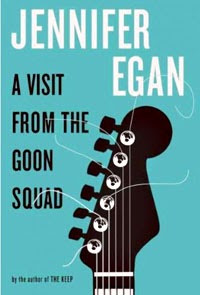
"...Goon Squad": Sneak Preview of 2011 Pulitzer Winner for Fiction

I had not heard of Jennifer Egan's sprawling novel "A Visit From the Goon Squad" until this week, when I learned that it won the 2011 Pulitzer Prize for Fiction.

Given that THE high-profile literary event this year was Jonathan Franzen's novel "Freedom", it came as a surprise that Franzen was not even cited among the other two finalists (those being "The Privileges" by Jonathan Dee and "The Surrendered" by Chang Rae-lee.)

Now that I know something about Egan's prize-winning novel, I can't wait to read it.  From the book's description, it seems to be a complex interconnecting of characters in a story about the music industry, and about Baby Boomers aging in a world of runaway technology.  The "goon" in the title is, apparently, the relentless passage of time, from whose visitation none of us escapes.  In a terrific book review in The Guardian , critic Justine Jordan remarked as follows:

"Throughout the novel, characters strain to apprehend time and its effects on the flux of personality – that desire, as Sasha puts it, to be able to say "I'm changing I'm changing I'm changing: I've changed!" Egan's chronologically jumbled structure is the perfect vehicle to express this, shuttling the reader between prophecy and hindsight."
I was immediately attracted to this, because I would like to think, in some very modest way, I am doing the same thing with this journal.

I re-visit the past (favorite films, personal anecdotes about growing up), write about things I love, share new endeavors, and comment on this obstacle-course of a world.  I do this in order to find acceptance, cry foul if justified, and make personal discoveries. I want to entertain my friends, and feed my art....It is sometimes like a river changing its course, sometimes like a butterfly's metamorphosis.  "Prophecy and hindsight."  Yes!

The idea of "reinventing" one's self: of trying intentionally to effect life changes, of returning to the guideposts of one's history, of losing one's way before suddenly realizing something HAS changed....that is what I have hoped to chronicle on these "pages".  

I feel like I am in the very midst of this journey, not only of finding new purpose, while making my current strengths more meaningful, but of continuing to define the meaning of "reinvention". 


It is the kind of artistic expression promised by novels such as "A Visit From The Goon Squad" that can help refresh one's efforts, renew one's inspiration, and offer new directions.

Whether I leave a legacy of film reviews or fiction, whether I have an epiphany in another part of the world, whether I find life's meaning among the voiceless creatures around us...that's what I continue to seek, with this Journal as my playground, my laboratory, my stage.

* * * *
A full list of Pulitzer Winners can be found here.  Those of you I follow here, and who are kind enough to signal their visits with comments, will one day be on this Pulitzer list....and I hope to join you.

I was happy to see that our own Chicago Sun Times was victorious in the category of Local Reporting, for their series on the devastation that gun violence has on Chicago neighborhoods (Frank Main, Mark Konkol and John J. Kim).  The beleaguered Sun-Times needed this recognition, its first Pulitzer since 1989.  (Roger Ebert won the Prize for his film criticism in 1975.) 

The massive snowstorm in early February almost cost them the award.  It was the final day to submit entries, with few forms of transportation running on the treacherous roads, and the journalists were desperate to get their work out on time.  Finally, a lone UPS worker who was still at the office scanned the package and the delivery was made on time.  The rest is Pulitzer history.


Thursday, February 3, 2011

Book Review: "Another Enchanted April"

Writer and blogger Eric Arvin composes contemporary romances about gay men in situations that are ripe with the promise of tender love, sexual fantasies fulfilled, secret yearnings, and the revelation of secrets.  He had written a more somber tale about that hotbed of gay lust, the college campus, in his previous book I read, "The Rest is Illusion." His latest, "Another Enchanted April", is a romantic comedy.  It follows a lighthearted and life-changing journey made by his three protagonists on a vacation to an Italian-style seaside manor, with its lush and magical gardens, in an unidentified American coastal town.


Like "Illusion", Arvin smartly narrows his story to a manageable frame of time (about a week) and concentrates on the development of a small number of characters.  In this way, he is able to tell a straightforward narrative, woven through with threads of of detail, and allows readers to become familiar with his characters as though they were our intimate friends. "Another Enchanted April" is a breezy read, and although there are attempts at literary allusion and mildly profound insights into the often amusing intrigues of gay sensibility, the strength of this fast-moving novel is that it is entertaining.  It's a perfect companion for a day on the beach in Provincetown or a relaxing weekend in Golden Gate Park.


We follow three likable young men, long-time friends about to have an April adventure, while dealing with their physical preoccupations and romantic explorations.  Tony Fisher is the least confident, owing to an injury caused by a mysterious accident that has left him in need of a cane.  Tony has retreated from the world and given up hope of finding love.  He is cajoled and finally kidnapped into joining his two friends on this trip, Doug Dester and Jerry Wilkins.

Doug is Arvin's concoction of every gay man's fantasy:  muscular, irresistible, sexually playful, aware of his attractiveness and casually accepting of the adoration that comes his way.  Jerry, a plain and wispy intellectual who knows books,  secretly carries a torch for Doug, and must learn to find his self-confidence to step out of Doug's shadow.

"Enchanted April" may have provided Arvin with something else.  Given what we know of the author from his blog, I wondered if Arvin found a source material that allowed him to explore three different facets of his own life.  That could account for how intimately Arvin knows these characters, and how he effectively shifts the book's point of view between all three of them.

Arvin creates for his trio some hilarious and touching episodes, and surrounds them with interesting characters: Sal, the darkly handsome gardener who is Tony's salvation; the sharp-tongued cook Anna Magnani (no relation to the actress) and her pretty son Gio; and a rogue's gallery of gay types, narcoleptic bodybuilders, sleazy middle-aged doctors, wisecracking drag-queens, broad-backed rowers and frisky sailors.

The book is loosely structured on the 1992 movie (in turn based on a 1922 novel) about four English women who come together and are transformed by their time in an Italian villa.  Arvin even borrows the original last names of some of the characters for reference and for satire, and includes a delightful image from the original that is telegraphed the moment Tony gives up his cane.  There are also an abundance of Shakespearean motifs, starting with the guys' alma mater, Verona College, and carrying through to some of the chapter headings and humorous takes on character names.


In fact, there are a number of self-conscious references to everything from Shakespeare, to "A Room With A View", "Dirty Dancing", Ingmar Bergman (I smiled), symbolism, and things that please English professors.  Arvin is having some fun here, although I don't think these always work, as they take us out of the story, which has plenty of material for humor.  When Arvin's Jerry muses that every sentence in a novel must have two things--purpose and beauty--Arvin risks exposing his own writing to undue scrutiny. 


In the end, however, the story finds our heroes seeking and finding love in surprising ways, and it is to Arvin's credit that, comic implausibilities aside, we care about the resolutions to each character's searches.  I  think it's unnecessary for the author to spell out the meanings and morals of each character's story, and hope that Arvin finds the confidence in his well-written characters to let their stories communicate that meaning through description and well-observed incident.  In fact, Arvin's greatest strength is in descriptive writing and character development.  The villa he creates is as real as any place I could imagine, and I have a clear picture of all of his characters and their foibles and nobilities. I like them.


Eric Arvin is a good writer.  I encourage him to have fun with his romances, and also to consider applying his talents to more serious examinations of the gay experience, which will be of truly lasting value to his readers some day.

Wednesday, January 19, 2011

A Special Book: "Just Kids" by Patti Smith

Patti Smith's memoir "Just Kids", is so intimate, I felt like she was looking at me while I was reading it.  Her story of New York bohemians living in an atmosphere of self-discovery and commitment to art made a gentle and indelible impression on me. 

It was a world I have romanticized; one that I yearned to have been a part of.  The late 1960's. A time of creative, social and political ferment. 

It was a world of Andy Warhol and "Midnight Cowboy";  a world of Automats and Nathan's hot dogs and poverty and idealism; of the Chelsea Hotel and the Factory; of Janis Joplin and Sam Shepard and Alan Ginsburg and Viva and so many others still finding their way; of "Hair" and Woodstock, Jim Morrison and Jimi Hendrix.

Of 1967, 1968, the drug culture and poetry and turning discarded objects into works of art.


(Names are dropped casually, like they were just neighbors.  Names and places that are are heavy with significance, that blossom with nostalgic connotations.)

Of mysticism and fashion, and books and art and sexual discovery and anything goes.

The world of Patti Smith and Robert Mapplethorpe.


This is Patti Smith's story of her days as a young artist, moving to New York to pursue her poetic dreams.  Living on the street, she meets the charming and sexually ambiguous Mapplethorpe, and thus begins their sweet loving friendship, and a vow that they would always be there for each other.

Amid their developments, their triumphs, their failures, their artistic experiments and soul-searching, their separate love affairs, their travels and their squalid rooms which they made into a home, they kept that vow.

These two people, with the souls of poets, one a future rock star and the other a soon-to-be photographer-provocateur, supported one another's fledgling artistic visions.

Among many other things, this is a terrific story of love and friendship.


The writing here is exquisite.  I hung on every sentence, written simply, clearly, bejeweled with detail of the everyday as well as the unusual.


I loved her delicate descriptions of their processes of creating art;  and pondered with awe their philosophies.  For Mapplethorpe, art was like holding hands with God and singing.  For Smith, the challenge is to create something significant, as art must illuminate.


Smith  describes her family and that of Mapplethorpe's, creating  full portraits in small sketch-lines.  Both came from religious backgrounds, which each rejected, but that yet still infused their art.  She perfectly blends this straightforward personal narrative with musings on creativity that went straight to my core and inspired me.


I especially adore Patti Smith's love for the book as an object of art, as well as a vessel for artistic expression.  She describes having supported herself by working in various bookstores and by buying obscure books and selling them to collectors for profit.  I was proud to see her champion the humble book, which I maintain will not soon die.

"Just Kids" is a marvelous, special work about creative struggle and poetry and finding ones' artistic soul, set in a time period which always fascinates me.  It is certainly one of the best memoirs I have ever read. 

I loved this book.  It rightly deserved to win this year's National Book Award.

And it put me in the right frame of mind for my next series: The Movies and Oscars of the Year 1970.

Wednesday, January 12, 2011

Mark Twain's "Huckleberry Finn" is Given a "Whitewash".

"Persons attempting to find a motive in this narrative will be prosecuted; persons attempting to find a moral in it will be banished; persons attempting to find a plot in it will be shot." (Mark Twain)


~  ~

  ..."Displace one note and there would be diminishment. Displace one phrase and the structure would fall..."  (Salieri in "Amadeus" by Peter Shaffer)


Some works of art  have achieved a certain fragile perfection that is ruined if they are even slightly altered. Other, more modest works still have an integrity that should not be meddled with. 

For years, I have loathed the following words:  "This film has been edited for content"....

Next month, an Alabama Publisher will release a version of Mark Twain's undisputed classic "The Adventures of Huckleberry Finn".  They are promoting the book to be used in schools that had banned it due to language.  The new book has removed an offending word, used repeatedly, and substituted it with the word "slave."


Okay, I will use the offending word only once (it even looks ugly on the page)...."nigger".


The odd thing is that I am personally uncomfortable using the word in any context.  The irony of my hesitation, while defending its use by another author, makes me laugh with some embarrassment.


Such is the power of words.  Which is why we need to be careful to understand their connotations, and the deliberate choices a gifted author makes to enrich a work and give it shades of meaning.  The well-intentioned substitution of a more "benign" word can destroy a work's important subtext, and eliminate the very reasons why it has endured in the first place.


In other words, a "cleaned-up" version of "Huck Finn" is still a good yarn, appropriate for a grade-school or even a high school reader, but it is no longer suitable for academic, critical study. 


Painful as history might be, it's no use to whitewash literature and deny the existence of troubling reality as reflected through language, especially language used as an artistic and social comment, or as a snapshot of the society in which a work was created. 


The "N-word" (as I will now refer to it) is loaded with pain, anger and utter contempt.  However, use of the word was less contentious in Mark Twain's day.  Reading "Huck Finn" with its language intact might make for a richer and more effective educational experience.  

Students might consider the evolution of the word; WHY it was more acceptable then; how it has grown in volatility; and why a segment of the population has commandeered it.  That leads to a meaningful discussion about an unfortunate period of history, and what the repercussions are today. 


I think that would be impossible without the actual text, and its ability to create tension in the reader through its language.


Perhaps "Huck Finn"  is not appropriate to teach at all grade levels or in all schools; perhaps some teachers ought not attempt it in their classrooms before dealing with their own discomfort. 


Fortunately the original is still everywhere, and easy to find, in libraries (that haven't banned it), bookstores, or on-line.  It would be great if this "controversy" introduced the book to new readers, or prompted others to read it again. 


However, the new version will soon be out there.  I wish they would follow the example of some TV stations, and put the following on the cover: "This Book Has Been Edited for Content".


FIRST POSTSCRIPT : Film Critic Roger Ebert put forth a controversial Tweet upon hearing of the alteration of Twain's book, claiming he "would rather be called a 'n....' than a 'slave' ".  He soon recanted this, after a firestorm of angry re-tweets, realizing that he is "not likely to be called either", and that he should have "shut the f--- up".  Maybe Roger was careless, and his comment a little misguided, but I give him credit for his passion.


SECOND (AND FINAL) POSTSCRIPT:  My guess is that Mark Twain himself would have been delighted with this controversy. In fact, the book has been getting banned from the get-go:


The Adventures of Huckleberry Finn was first published in 1884. Mark Twain wrote to Charles Webster on March 18, 1885: "The Committee of the (Concord) Public Library ... (has) expelled Huck from their library as 'trash and suitable only for the slums.' That will sell 25,000 copies for us sure."

In 1902, the Brooklyn Public Library banned The Adventures of Huckleberry Finn with the statement that "Huck not only itched but he scratched," and that he said "sweat" when he should have said "perspiration."
http://classiclit.about.com/od/huckleberryfinnfaqs/f/faq_huck_ban.htm


Monday, January 10, 2011

Coming Soon......

*

Stay tuned for the following topics this month....


"HUCKLEBERRY FINN": A cleaned-up version of "Huck Finn" has been published, in which all references to the "n-word" have been removed, prompting outcries about artistic integrity, censorship, and how art  reflects the society in which it was created.


OSCARS 1970: The Second Annual  look back at the Academy Awards 40 years ago!  I will captivate you with stories such as:   
--Three (count 'em) war films from 20th Century-Fox;
--A box-office smash with the most nominations (10) directed by a veteran who helmed Natalie Wood and Santa Claus in 1947; 
--The first Oscar-winning performance with a nude scene; 
--A veteran actor who wins without a line of dialog;
--An Oscar nomination refused;
--Vietnam by way of Korea;
--The first Native American acting nominee (come to think of it, the last, too);
--And the most famous chicken salad sandwich in the history of the movies! 


Patti Smith's memoir. "JUST KIDS".  I am excited to recommend it to anyone who cares about art and artists.  And anyone who wants to revel in the era of 1960's music, Warhol, Woodstock, and Bohemian New York.


The week has had a solemn beginning..   Time to rest, and move forward refreshed...  Sleep obliviously, like a dog... look for a new way to see the morning...   Every day is an opportunity to reinvent one's self.... 


Monday, December 20, 2010

Book Review: “The King’s Speech” by Mark Logue and Peter Conradi

As the new film “The King’s Speech” is released to great acclaim and Award recognition, there is a renewed interest in the story of King George VI of England and his friend and speech therapist, Lionel Logue.


Now, Sterling Publishing has released a new book of the same title, written by Logue’s grandson Mark Logue with Peter Conradi, a wonderfully detailed and marvelous human chronicle.  It's worth a look, both as a tie-in to the film which inspired it, and on its own as an exciting read.


“The King’s Speech” interweaves two stories: King George’s sudden ascent to the throne after the abdication of his brother, and his terror of public speaking due to a lifelong stammer; and a full account the life of Lionel Logue, the prominent Australian elocutionist, who helped wounded and traumatized soldiers regain their ability to speak.


The authors expand the story beyond the WWII years to include a full account of Lionel’s life and travels, the King’s troubled upbringing and ascension to the throne, the influence of their families and friends, and the eventual meeting and working relationship between King and Counselor.


The book is a labor of love by Logue, who was inspired to write it after the filming was completed, and after he discovered his deceased grandfather’s files full of letters, diaries, newspaper clippings, and photographs. Even the book’s larger-than-life subtitle (How One Man Saved the British Monarchy) tells us that Logue’s account will be an admiring, un-critical one. It is as much a tribute as a biography.

Far from being stodgy and dry, it is filled with surprising and often amusing insights into important figures, and is set against glorious locations during the most significant events of the Twentieth Century. Especially fun are early passages describing Logue’s and his wife Myrtle’s travels to America, how they enjoyed Chicago,  loved the drug stores, cafes and automobiles there, but were unimpressed with the bad manners of the local women.

(Being a native of the “Second” city, I was even more amused at the accounts of New York as “a city of atrocities and lawlessness.”)


Logue and Conradi do an admirable job of going through a mountain of material to write a clear, well-paced, and often suspenseful account. The book begins on the day of George’s coronation.  It then flashes back to the beginnings of each of these men’s lives, proceeding chronologically through World War II and the famous Speech, and on to their final days. 

While the firsthand materials dictate the amount of depth possible, and while there are few attempts to speculate or analyze, the writers stay true to their intention to illustrate how history was moved through the better efforts of human nature.


“The King’s Speech” makes a solid case for the importance of good speaking and clear thinking, and made me excited about the possibilities of examining and improving my own elocution. Snippets of Logue’s diaries proved inspiring:


“There is a mistaken idea that ‘hustle’ implies achievement, whereas it really means a wrong use of energy and is an enemy of beauty…The English voice is one of the finest in the world but its effect is often spoiled by wrong production.”


The book itself suggests that the arts of persuasive speaking, letter-writing, and the keeping of detailed diaries, may be fading, but need not be forgotten; and that they may even have their place in modern discourse, and as a legacy for historians.


For me, what makes this almost-forgotten, historical human-interest story still relevant today is the depiction of the positive effects of true friendship on any two lives, regardless of their stations in life, disabilities, or advantages:


“The King took two steps to the table, and Logue squeezed his arm for luck. The gesture spoke volumes about the closeness of the two men’s relationship; no one was meant to touch a king unbidden in that way. … There was nothing for Logue to do but just stand and listen, marveling at the King’s voice. When he had spoken his last words…the two men continued to look at each other in silence--‘the King and the commoner and my heart is too full to speak’. The King patted him on the hand."


If you are looking for a gift for a reader of history, a student of human nature, or a lover of movies, “The King’s Speech” is an excellent choice.


http://search.barnesandnoble.com/The-Kings-Speech/Mark-Logue/e/9781402786761


http://www.amazon.com/Kings-Speech-Saved-British-Monarchy/dp/140278676X


Here’s a look at Mark Logue, and some actual footage of people and events told in the book:

Thursday, November 18, 2010

National Book Award Winners: A Long Shot and a Sentimental Favorite


Award Season continues with the announcement of The National Book Awards Tuesday of this week.


Awards like this help draw attention to literary works that would otherwise go unnoticed by the general reading public.  While an award is no guarantee of unimpeachable artistic quality, it helps define the cultural and artistic preferences of the moment, and I think literary awards like NBA and the Pulitzer (in April) at least attempt to recognize something lasting and universal. 

This year's winners in the Fiction and Non-Fiction categories are notable.

The Fiction Prize was awarded to Jaimy Gordon for her novel about the world of cheap horse racing, "Lord of Misrule."  Gordon was considered the darkest of dark-horses, so to speak.  She herself felt she was a long-shot from the start.  Gordon's publisher pushed her to finish her tale of lowlifes, losers, and one remarkable woman who loves horses, in time to be submitted for nomination for the Award.  Gordon thought he was crazy.  Finish she did, and was surprised to be among the five finalists...and the eventual winner.  The book is starting to gain a solid critical reputation. 

(Other Fiction finalists were: Peter Carey, "Parrot and Olivier in America"; Nicole Krauss, "Great House"; Lionel Shriver, "So Much for That"; and Karen Tei Yamashita, "I Hotel".)


The Non-Fiction Award went to artist, performer and punk icon Patti Smith for "Just Kids", the story of her friendship with gay photographer Robert Mapplethorpe.  The book has been widely praised, and is definitely on my short list of must-reads.

Smith gave a heartfelt, tearful thank-you to nearly 1300 attendees, as reported in the story on NPR:
"I have loved books all my life," she said, reminiscing about her time as a clerk at New York's Scribner bookstore. "I dreamed of having a book of my own, of writing one that I could put on a shelf."
Smith also...gave a teary defense of the book as a physical object. "There is nothing more beautiful than the book," she said. "Please don't abandon the book." The applause in the room after her speech was close to thunderous...and Smith seemed to win two awards at once: an NBA medal, and the room's heart.
(Other Non-Fiction finalists were: Barbara Demick, "Nothing to Envy: Ordinary Lives in North Korea"; John W. Dower, "Cultures of War: Pearl Harbor, Hiroshima, 9-11, Iraq"; Justin Spring, "Secret Historian: The Life and Times of Samuel Steward"; and Megan K. Stack, "Every Man in This Village Is a Liar: An Education in War".)


Wednesday, October 6, 2010

"Superman" An Important Topic, A Mediocre Film--Tuesday Journal


I could write all night about public education and its failures.  One of the best histories of American education, and of the origins of American contempt for the educated, is Richard Hofstadter's "Anti-Intellectualism in American Life", a Pulitzer Prize winner in 1966.

The book analyzes an early American attitude that educated people, usually  from the European countries of origin for many settlers, were "elitist" and "decadent".  American teachers were often picked from the dregs of society; or the profession was seen as a soft, "feminine" occupation  not worthy of workers of professional caliber.  Populism and practicality, and brawn over brain, were what were required to build a nation.  (Read some of the passages and substitute the word "homosexual" for "intellectual" and the meaning becomes more sinister, and relevant to "now".)

From Christopher Hefele's review on Amazon:

"...Turning to education, Hofstadter points out that broad public education in the US was started not for developing the mind or the pride of learning for its own sake, but for its supposed political and economic benefits. Children were viewed not minds to be developed, but as citizens to be trained for a stable democracy..." 

While that may be necessary to some degree, President Obama's Community College Summit today was an uncomfortable example of this notion, taken to the extreme.  We have all but given up on our respect for learning for its own sake.   Smart people are threatening.  We laugh off  ignorance.  Now that we are suffering the waste brought about by America's benign neglect of intellect, and are slipping in world stature as an educated society, we are of necessity looking at higher education as simple job training, and not as a way to enlighten, and make more civilized, our society as a whole.

Since we have not insisted on the importance of serious learning and thought, we now have the tools and technology for unsurpassed communication and sharing of knowledge, but have not developed the minds to use these tools to their greatest potential.  Instead, we play games, make "friends", satisfy our appetites... in short, the tools have become ends in themselves.  Much of our intellectual currency is spent on creating gadgets for our entertainment.   

And we haven't the time or capacity to examine the fallout from our neglect and contempt of education: the idea of right to privacy, what constitutes free speech; the protection and ownership of original thought; the harnessing and regulation of hate; the ignorance and passivity of the electorate; the emergence of unchecked misinformation passing as truth; the rampant and all-pervasive evil of corruption.

And, like the economy, bullying has gone global...with horrible results....Whereas teasing and bullying were once confined to the school and neighborhood, where victims had a reasonable chance of dealing with it as a natural annoyance of growing up; it's now possible to humiliate a classmate on the world wide web.  Bullies, it seems, have emerged from the schoolyards and taken over the world.  There are economic bullies, religious bullies, and  fear- mongers of all kinds.  And, like teachers on the playground who might exercise reasonable controls, our society's checks and balances are missing or complicit: an objective press; an honest government; a trustworthy economic system.


So I was totally invested in the subject matter of the new documentary "Waiting for Superman", which purports to examine what is wrong with public schools, mostly in distressed areas of America, and what we can do to save schools, communities, and students. 

Sounds like others find this topic important too, as well they should. But I fear the praise garnered by the documentary is for it's attempt, but not for its result.  I thought the film mediocre, unfortunately.  It's thin on facts and serious discussion, and heavy on heart-tugging, using filmmaking techniques that I find dubious in the documentary form.

I knew going in that the system is broken, that there are incredibly gifted teachers doing innovative work, and that a chain of poverty, despair and crime have held many schools hostage.  I wanted to get more thoughtful discourse on how cultural attitudes, that have been with us for decades, can be untangled; and how teachers can overcome the monumental problems of violence and cultural complacency.

The best I can say about the film is that it stimulated thought and conversation.  But the movie missed many opportunities to clarify, and build upon the arguments it sought to make.

For example, it is stated that educational reformers, who once thought good communities made good schools, now believe that good schools actually improve the surrounding communities.  But nowhere does the film develop this notion. 

The idea that good teachers are required is common sense. Yet, the film never defines what a good teacher is.  Teachers' unions like the one in Washington DC are justifiably called to account for not allowing discussion on the idea of merit pay for good teachers, opting instead to preseerve the status quo and give all teachers equal increases, regardless of skill or classroom success.  But the film, so eager to create a scapegoat, seems to make the lazy assumption that teachers' unions are the central enemy. 


We are introduced to several young students and their families, the parents and grandparents, who lend their opinions about the state of their kids' schools, often within earshot of the kids, who no doubt pick up on these attitudes.  We follow the dilemmas of parents who must work multiple jobs, or deal with low pay or getting laid-off.  When a little girl is not allowed to attend her parochial school graduation because her mother missed a tuition payment, I felt like the filmmakers ought to help out in some way. (I had a similar reaction in "Hoop Dreams" when the basketball players' homes were cut off from electricity, but the filmmakers kept the cameras rolling.) 

I kept looking at the camera placements, and thought how the mere presence of the filmmakers rendered most of this footage stagey and less than honest.  It was as though the filmmakers set out to create an emotional atmosphere and shot the footage they wanted, rather than cover the material objectively. 

It's hard not to be moved to tears by the dilemma faced by many of these kids, as their chance to escape their circumstances and attend  well-run charter schools is determined by the whim of a lottery.  The point is made early; but the film presses these lottery scenes for easy emotion.  And then the film undermines this message---that lotteries are inequitable, humiliating and depressing--by asking us to cheer for one of the kids who gets admitted off the waiting list.  The whole phone call is filmed...no doubt, staged and set up in advance.  Kids, too, learn early how to "act" in front of the camera, and much of the spontaneity and genuineness is lost.

I liked the film best when it delivered data about reading and math proficiency (but again it failed to fully define these terms in context), or about the terribly unproductive way that tenure has evolved to protect teachers who are consistently late, abusive, or don't present the course material.  A lot is said about the effectiveness of schools in countries like Finland. I wanted to see what these countries were doing that we weren't, either due to resources, politics, or differences in cultural diversity and attitudes. 

About 20 minutes before the film ended, I suspected that there would be a web site, and an appeal for financial support from the filmgoers.  There was.

One critic said we need more films like this.  I agree.  But we need them produced and created by intelligent people who can untangle the complexities and provide compelling arguments based on good data, definitions, and examples.  I applaud Davis Guggenheim for an honorable try, but the finished product gets a B-minus from me.