Showing posts with label Education. Show all posts

Wednesday, October 12, 2011

An Alarming Contradiction--Job Openings Are Going Unfilled

Make the school day longer, and then cut access to a free educational opportunity?

(We'll return to the world of movies later this week.)

Chicago Mayor Rahm Emanuel caused a  furor recently by pressing legislation to lengthen the school day in Chicago Public Schools.  A typical school day had been from 9:00am-2:45pm, or 5 hours and 45 minutes. Emanuel sought to add about 90 minutes of additional instruction time per day.

Emanuel's primary concern, in an era when a well-trained workforce is crucial to a vastly changing job market, was that children would receive the additional instruction needed to prepare them for advanced study, or to qualify them for positions as skilled workers.

Then, I heard something that made me pause:

Today, Emanuel's first annual budget for the city was unveiled.  One of the many measures, proposed to close a multi-million-dollar deficit, was to shorten the hours at many Public Libraries.

That sounded to me like a mixed message.

Is Emanuel paying lip service to increased instruction and competitive education?  Why keep kids in school longer and then restrict citizens' access to materials that may help them learn and improve their lives?

As reported in the Tribune, libraries will be closed during their "least-used" hours.  But why not encourage heavier usage?  Why not turn the libraries into centers of workforce development and community education?  It makes no sense to decrease access to a center of free inquiry and self-improvement and education. 

Libraries should not be relegated to the dustbin of history.  There are a lot of materials, archived preserved, that are still useful, especially reference materials, that can still be used, to maintain a depth of knowledge, and a  more complete worldview.

I think it is dangerous to rely on the Intenet for all of one's information and instruction.  It's as absurd to think that the Internet is a reliable and objective source of all reference material, history, culture, and news, as it was assumed at one time that Television was all one needed for one's information and education.

Search engines are sponsored; search results as a result can be filtered.   Material on the internet is unfettered, much of it lacking the "antiquated" principles of accuracy and objectivity.  It's a wild frontier in many ways.

All of this feeds into my reaction to a surprising and disturbing story I have heard a lot recently, summarized well in the Huffington Post:

While 14 million people in the US are looking for work, 52 percent of U.S. employers have difficulty filling critical positions within their organizations -- up from 14 percent in 2010.

Many of the manufacturing jobs going unfilled require skills and knowledge in math and sciences.  In 1980 these disciplines accounted for 11.1 percent of college graduates. In 2009, it fell to 8.9 percent.

Older workers are retiring, and younger workers have either not applied to fill these vacancies, or else lack the proper background and training.  Many vocational training programs have been cut, or else are out of date.

We need to reinforce all opportunities to educate its citizens and potential workers, within the schools and within the community.  Make a case for extended schooldays (and, maybe, consider compensating teachers proportionately). Also, don't close a community center of free inquiry and exploration--the Public Library--but find ways to make it more active in workforce training.

American culture has to commit wholeheartedly to the idea of lifelong education, in all of its forms...and that means, not restricting access to educational materials, just to close a budget deficit.

Read the article to get an idea of the gravity of the situation in which thousands of jobs are going unfilled in this time of alarming long-term unemployment (which you can find on this link).

Thursday, March 3, 2011

Jean Brodie's Definition of Education...and the Crisis in Wisconsin


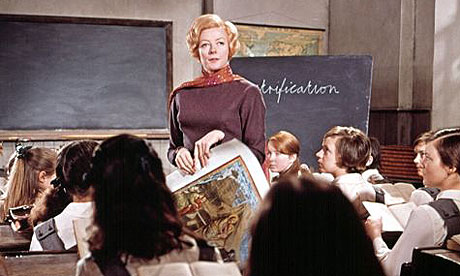
While reflecting on the economic crisis in Wisconsin that is being played out on the backs of teachers and other public workers, I happened to remember that great film, "The Prime of Miss Jean Brodie", and the expansive, complex, and romantic creation of Muriel Spark realized on-screen by the excellent Maggie Smith.


I mused as to whether Jean Brodie, teaching today in Wisconsin, would lead the charge against loss of Collective Bargaining Rights, whether she would have earned tenure at all (after inadvertently inspiring a hapless student to join a group of anti-American terrorists), or whether she would have paid any attention to labor politics, swept away as she was in the pursuit of Beauty, Honor, and Courage, in her prime.


I don't mean to make light of the terribly desperate situation in Wisconsin.  The Governor of the state seeks to cut spending, AND for some reason restrict collective bargaining rights for teachers, while Wisconsin Democratic Congressmen have fled the state in hiding in order to hold off a vote on the matter.


Amid all of this theater, there is little media attention to the students and what they stand to lose. 


Adults keep brandishing the word "education" until it has become a blunt instrument. 


I never forgot Jean Brodie's philosophy of education, nor her derivation of the word and how she viewed the process.  I had never considered it this way before, and from then on, it came to my mind with every endeavor at learning....


JEAN BRODIE: To me, education is a leading out. The word education comes from the root "ex," meaning "out,"and "duco..."I lead."
To me, education is simply a...a leading out...of what is already there.

HEADMISTRESS: I had hoped there might also be a certain amount of putting in.

JEAN BRODIE: That would not be education, but intrusion...from the root prefix "in," meaning "in," and the stem "trudo..." "I thrust."
Ergo, to thrust a lot of information into a pupil's head...

This is a wonderfully liberating and progressive idea...Of course, a certain amount of input is necessary; but the idea that each student can be observed so closely that the right kind of input is provided, to draw out each student's particular strength, is an educator's dream.  If there were enough money and commitment, if class sizes remained smaller and guidelines for measuring progress were expanded (rather than limited by mere standardized test scores), we might produce some significant learning, and see a big return on the investment in education.


Good teachers will work closely with students, inspire them  and draw out their strengths, whether they belong to a union or not, as long as they are provided with good working conditions and updated materials, fair hours, and competitive, decent wages.  Good teachers deserve at the very least these things, and the ability to demand them.


But we're in the midst of a dangerous time.  The pendulum has swung us back to the early 1900's, it seems.


It is ironic that Wisconsin passed one of the nation's first collective bargaining laws for public employees in 1959.  The state of Wisconsin was a leader in workers' protections, including workers compensation and unemployment benefits.  Here is a fascinating presentation published today by the Wisconsin Labor History Society. 


Without an historical perspective, Americans are easily convinced that workers and unions are the only demons in the current economic struggle.


Of course it is unfortunate that labor laws, so hard-fought and won, are unfairly abused by the lazy and the weak.  Yes, there are ineffective, even dangerous, teachers whose jobs are safe, while skilled, caring educators can't break into the classroom due to layoffs and the resultant lack of jobs.  Unions need to revamp their tenure laws to create new measurements of success.


But the deadbeats should not be used  as a rationale for rolling back protections and leaving outstanding educators vulnerable.


President Franklin Delano Roosevelt in a Senate address on May 8, 1937, said: “The right to bargain collectively is at the bottom of social justice for the worker, as well as the sensible conduct of business affairs. The denial or observance of this right means the difference between despotism and democracy.”
President John Fitzgerald Kennedy in 1962, signed an executive order giving public-employee unions the right to collectively bargain with federal government agencies. (Rancho Santa Fe Democratic Club)


I suspect, in the end, that Jean Brodie would put up a fight.  Whatever you think of her methods of instruction, she had an indelible and lifelong influence over her girls.  She would make mistakes, but she was passionate about education.  She would not be forced to resign.  She would give the Wisconsin Governor Scott Walker a piece of her mind.


"I am a teacher! I am a teacher, first, last, always!"

Wednesday, October 6, 2010

"Superman" An Important Topic, A Mediocre Film--Tuesday Journal


I could write all night about public education and its failures.  One of the best histories of American education, and of the origins of American contempt for the educated, is Richard Hofstadter's "Anti-Intellectualism in American Life", a Pulitzer Prize winner in 1966.

The book analyzes an early American attitude that educated people, usually  from the European countries of origin for many settlers, were "elitist" and "decadent".  American teachers were often picked from the dregs of society; or the profession was seen as a soft, "feminine" occupation  not worthy of workers of professional caliber.  Populism and practicality, and brawn over brain, were what were required to build a nation.  (Read some of the passages and substitute the word "homosexual" for "intellectual" and the meaning becomes more sinister, and relevant to "now".)

From Christopher Hefele's review on Amazon:

"...Turning to education, Hofstadter points out that broad public education in the US was started not for developing the mind or the pride of learning for its own sake, but for its supposed political and economic benefits. Children were viewed not minds to be developed, but as citizens to be trained for a stable democracy..." 

While that may be necessary to some degree, President Obama's Community College Summit today was an uncomfortable example of this notion, taken to the extreme.  We have all but given up on our respect for learning for its own sake.   Smart people are threatening.  We laugh off  ignorance.  Now that we are suffering the waste brought about by America's benign neglect of intellect, and are slipping in world stature as an educated society, we are of necessity looking at higher education as simple job training, and not as a way to enlighten, and make more civilized, our society as a whole.

Since we have not insisted on the importance of serious learning and thought, we now have the tools and technology for unsurpassed communication and sharing of knowledge, but have not developed the minds to use these tools to their greatest potential.  Instead, we play games, make "friends", satisfy our appetites... in short, the tools have become ends in themselves.  Much of our intellectual currency is spent on creating gadgets for our entertainment.   

And we haven't the time or capacity to examine the fallout from our neglect and contempt of education: the idea of right to privacy, what constitutes free speech; the protection and ownership of original thought; the harnessing and regulation of hate; the ignorance and passivity of the electorate; the emergence of unchecked misinformation passing as truth; the rampant and all-pervasive evil of corruption.

And, like the economy, bullying has gone global...with horrible results....Whereas teasing and bullying were once confined to the school and neighborhood, where victims had a reasonable chance of dealing with it as a natural annoyance of growing up; it's now possible to humiliate a classmate on the world wide web.  Bullies, it seems, have emerged from the schoolyards and taken over the world.  There are economic bullies, religious bullies, and  fear- mongers of all kinds.  And, like teachers on the playground who might exercise reasonable controls, our society's checks and balances are missing or complicit: an objective press; an honest government; a trustworthy economic system.


So I was totally invested in the subject matter of the new documentary "Waiting for Superman", which purports to examine what is wrong with public schools, mostly in distressed areas of America, and what we can do to save schools, communities, and students. 

Sounds like others find this topic important too, as well they should. But I fear the praise garnered by the documentary is for it's attempt, but not for its result.  I thought the film mediocre, unfortunately.  It's thin on facts and serious discussion, and heavy on heart-tugging, using filmmaking techniques that I find dubious in the documentary form.

I knew going in that the system is broken, that there are incredibly gifted teachers doing innovative work, and that a chain of poverty, despair and crime have held many schools hostage.  I wanted to get more thoughtful discourse on how cultural attitudes, that have been with us for decades, can be untangled; and how teachers can overcome the monumental problems of violence and cultural complacency.

The best I can say about the film is that it stimulated thought and conversation.  But the movie missed many opportunities to clarify, and build upon the arguments it sought to make.

For example, it is stated that educational reformers, who once thought good communities made good schools, now believe that good schools actually improve the surrounding communities.  But nowhere does the film develop this notion. 

The idea that good teachers are required is common sense. Yet, the film never defines what a good teacher is.  Teachers' unions like the one in Washington DC are justifiably called to account for not allowing discussion on the idea of merit pay for good teachers, opting instead to preseerve the status quo and give all teachers equal increases, regardless of skill or classroom success.  But the film, so eager to create a scapegoat, seems to make the lazy assumption that teachers' unions are the central enemy. 


We are introduced to several young students and their families, the parents and grandparents, who lend their opinions about the state of their kids' schools, often within earshot of the kids, who no doubt pick up on these attitudes.  We follow the dilemmas of parents who must work multiple jobs, or deal with low pay or getting laid-off.  When a little girl is not allowed to attend her parochial school graduation because her mother missed a tuition payment, I felt like the filmmakers ought to help out in some way. (I had a similar reaction in "Hoop Dreams" when the basketball players' homes were cut off from electricity, but the filmmakers kept the cameras rolling.) 

I kept looking at the camera placements, and thought how the mere presence of the filmmakers rendered most of this footage stagey and less than honest.  It was as though the filmmakers set out to create an emotional atmosphere and shot the footage they wanted, rather than cover the material objectively. 

It's hard not to be moved to tears by the dilemma faced by many of these kids, as their chance to escape their circumstances and attend  well-run charter schools is determined by the whim of a lottery.  The point is made early; but the film presses these lottery scenes for easy emotion.  And then the film undermines this message---that lotteries are inequitable, humiliating and depressing--by asking us to cheer for one of the kids who gets admitted off the waiting list.  The whole phone call is filmed...no doubt, staged and set up in advance.  Kids, too, learn early how to "act" in front of the camera, and much of the spontaneity and genuineness is lost.

I liked the film best when it delivered data about reading and math proficiency (but again it failed to fully define these terms in context), or about the terribly unproductive way that tenure has evolved to protect teachers who are consistently late, abusive, or don't present the course material.  A lot is said about the effectiveness of schools in countries like Finland. I wanted to see what these countries were doing that we weren't, either due to resources, politics, or differences in cultural diversity and attitudes. 

About 20 minutes before the film ended, I suspected that there would be a web site, and an appeal for financial support from the filmgoers.  There was.

One critic said we need more films like this.  I agree.  But we need them produced and created by intelligent people who can untangle the complexities and provide compelling arguments based on good data, definitions, and examples.  I applaud Davis Guggenheim for an honorable try, but the finished product gets a B-minus from me.

Saturday, May 1, 2010

Can Entertainment and Sports Save Illinois Schools? A Friday Journal


I want to offer a solution to a state crisis. I have an idea that might equitably save Illinois schools and put teachers back to work. 

This is a post of regional interest.  Of course, Illinois, and Chicago in particular, have been in the spotlight quite often in the last couple of years: for example, President Obama; the failed Olympic bid; Tony Rezko; ever-increasing violent crime; and a clownish legislature laboring under the shadow of a recurring nightmare of a former Governor.  So, maybe non-residents will find some interest here too. 

Briefly, Illinois' economy is in dire trouble, and no one can agree on an new source of adequate funding to keep Illinois education solvent, relevant, and competitive.  Governor Pat Quinn has advocated for raising the state income tax from 3 to 4 percent to raise money for Illinois schools.  Property taxes are already stretched to their breaking point, and the contribution of the Illinois Lottery, while supposedly funding K-12 through losing ticket revenue, is highly overstated.

Quinn has proved to be a lot more respectable than his disgraced predecessor, Rod Blagojevich (lately a contestant on Donald Trump's show "The Apprentice").  Many of us in Illinois wish Blagojevich and his haircut would just go away.  But the investigation into charges of  corruption, which prompted his impeachment while in office, is threatening to extend its sorry reach all the way to the White House.  Stay tuned.

Yet Quinn has yet to make a convincing case to voters and lawmakers.  The state budget deficit is so bad, with so few state payments being made, that some colleges have been in danger of closing their doors; teachers have been laid off, leaving qualified educators in an ever-increasing pool of unemployed teachers, and preventing talented new teachers from finding jobs in Illinois; class sizes are increasing to unmanageable levels; and extracurricular programs like athletics and music are losing funding.

It is not surprising that the income tax increase not politically popular.  Even Quinn is demurring, putting forth a possible cigarette tax, and threatening to force the legislature to remain in session until they create a satisfactory budget.

I have a simple solution:

Add $1 (or a percentage of a dollar) to every sporting event, movie  play, opera, or concert ticket, and contribute this revenue to education funding.

Even in a bad economy, entertainment venues continue to thrive, for the most part.  And most of us use them, whereas a relatively small portion of the population smokes cigarettes.  Arts and entertainment and sports can be  educational experiences in themselves, or they can be distractions in the pursuit of education.  However they are perceived, a tax on this form of activity makes sense, and is an appropriate source of revenue to a worthy cause.

Wrigley Field fills its seats consistently during the baseball season.  With about 40,000 seats, one game would fund one teacher's salary for a full year.

Movie ticket sales provide even more volume, all year long.  Just take one film--"Avatar"--which grossed $746, 600, 000 at the very least (assuming, for the sake of simplicity, that this was all generated in the US).  At $10 per ticket, which is conservative because of the 3-D markup, that's roughly 74 million tickets sold. To simplify, divide that by 50 (states); Illinois' equal share would raise over a million dollars in education revenue, from just one movie.

Multiply that by all of the movies, Bulls and Bears games, Concerts at Ravinia, or the Lyric Opera, or the Chicago Theater or Allstate Arena, and all the many, many others.. Considering how ticket prices for all sorts of entertainment venues increase with no notice, without adversely affecting ticket sales, how many people would even miss the extra dollar? And few, I believe, would protest the use of this money to help fix Illinois education.