Showing posts with label Art. Show all posts

Tuesday, October 4, 2011

"Red" A Play Of Ideas, Beautifully Performed

"Maybe I'm a dinosaur talking.  Maybe I'm a dinosaur sucking up the oxygen from you cunning little mammals hiding in the bushes waiting to take over.  Maybe I'm speaking a lost language unknown to your generation.  But a generation that does not aspire to seriousness, to meaning, is unworthy to walk in the shadow of those who have gone before, I mean those who have struggled and surmounted, I mean those who have aspired...."
(--Mark Rothko in John Logan's "Red")

John Logan's Tony-winning "Red", now playing at Chicago's Goodman Theater, is a 2-character dialogue about art and ideas, that is inspiring, exciting, and unnerving.  It is a play for artists, consumers and appreciators of art, and art critics (or anyone who aspires to any of these.) 

The magnificent Edward Gero plays abstract expressionist painter Mark Rothko, at the height of his popularity (and controversy), circa 1958.  Into his life walks Ken, (the lithe and boyish Patrick Andrews), a young painter who has applied for the job as Rothko's assistant.  Ken, a fictional foil that Logan created to give Rothko a voice for his turmoil, listens to Rothko's philosophy, tries to get Rothko to notice him and his own artistic efforts, and then angrily challenges him for selling out. 

As the play opens, Rothko, whose art is a statement against banality, has just accepted a commission by the Four Seasons Restaurant to paint murals for the walls of the newly-opened establishment. Rothko's disheveled and grungy studio is the setting for this play.

An artist and his new young assistant.  A master and a novice.  Employer and employee. 

They proclaim themselves, yet struggle to understand each other. They become inextricably entwined, and yet violently resist one another.  It's a tug of war with Art as the object of their tugging, each one holding tight, each testing the strength of his sensibilities in an ever-more dramatic and heated contest of wills and opinion.

That is "Red."


An opening monologue describes the best way to "see" a painting (or most any other creative work:)

"Stand closer...You've got to get close. Let it pulsate.  Let it work on you. Closer. (Not) too close.  There. Let it spread out. Let it wrap its arms around you; let it embrace you, filling your peripheral vision so nothing else exists or or has ever existed or will ever exist.  Let the picture do its work--But work with it.  Meet it halfway...Engage with it!...  Be a human being for once in your life!  These pictures deserve compassion and they live or die in the eye of the sensitive viewer, they quicken only if the empathetic viewer will let them. That is what they cry out for.  That is why they were created.  That is what they deserve."
(--Mark Rothko in John Logan's "Red")

Logan may have written this play to challenge his own place in the artistic pantheon of writers. In awe of the giants who have gone before who inspired him, he must come to terms with the changes in taste and style and technology that dictate new forms of art, and new ways of creating art, that could render himself obsolete.  I, too, struggle with this notion.  Perhaps most people who are creative today must confront this idea more and more.

The play raises many questions to ponder.  Does the "new" in art render that which came before obsolete?  Can one subvert history without knowing history?  Can one create art without knowing one's place in the artistic continuum?  Is true art always "significant"?

"You know, not everything has to be so goddamn IMPORTANT all the time! Not every painting has to rip your guts and expose your soul!  Not everyone wants art that actually HURTS!  Sometimes you just want a fucking still life or landscape or soup can or comic book!....." 
"...You're just mad because the Barbarians are at the gate.  And, whattaya know, people seem to like the Barbarians."
(--Ken in John Logan's "Red")


(Mark Rothko)

I suspect Logan leans closer Rothko's view; the dialogue he has written for him is sure and strong.  Logan works hard to reconcile himself to new ideas about art, to adopt them so as to remain "relevant".  Yet, while Ken's monologues are delivered with much volume, I could not be sure if Logan was as convincing with these ideas, or believed in them as much.  (Warhol is used as an example of the cutting edge at the time, and his mention gets a few ironic laughs, but I wasn't sure if it was a fair example.)

Still,  Logan accurately describes the fear of obsolescence as a kind of death, as "the black swallowing the red", of "being weighed in the balance and found wanting".

I loved watching this play.  In spite of a tiny loss of conviction toward the end, when Rothko seems to have capitulated to Ken and his desire to stomp on Rothko's artistic demise, I admired and appreciated the audacity of a play about intangible things, set in a artist's messy studio, and played impeccably by two able actors.  I felt as though I had discovered a treasure box of valuable items that I thought might be swept away forever in the tide of modernity. 

I loved how the play introduces shadings from Rothkos' life without dragging it into simple chronology.  For instance, in a scene late in the play,  Ken finds Rothko drunk, his arms dripping with red paint, in a subtle allusion to Rothko's actual demise, from suicide, and having been found by a young assistant.

Viewers can revel in discussions about art vs. "business", about the way artists love their works like children, about excess vs. restraint, about Michelangelo and Pollock, and about collectors who buy art to match their decor; but, like Rothko's art, these discussions pulsate, and are never dry.

As Rothko, Edward Gero commands the role with a terrific voice and a close resemblance to the artist.  He makes these words his own; he exudes passion and menace, and actual affection for the paintings that he refers to as "blind children being turned loose in a room full of razor blades."  In the role of Ken, with no real-life counterpart, Patrick Andrews creates a believable character, moves well on stage (I loved watching him as he and Gero primed a canvas) and puts some real strength into his delivery.  Andrews often drains himself of gesture, allowing his vocal inflections to carry shades of meaning. 


Personally, I took comfort in and found inspiration from Rothko's point of view as expressed by Logan in this play.  His attitudes can be easily applied to all arts, to anyone who celebrates their highest humanity by seeking the fullest, deepest experience art can provide....even to someone who enjoys writing about film:

"You have a lot to learn, young man. Philosophy. Theology. Literature. Poetry. Drama. History. Archaeology. Anthropology. Mythology. Music. These are your tools as much as brush and pigment. You cannot be an artist until you are civilized.  You cannot be civilized until you learn. To be civilized is to know where you belong in the continuum of your art and your world.  To surmount your past you must know your past."
(--Mark Rothko in John Logan's "Red")


Wednesday, September 28, 2011

Why Marilyn? Why Chicago?

*
This past July 15, a new sculpture called "Forever Marilyn", by pop-artist J. Seward Johnson, was installed in Pioneer Court on Michigan Avenue's Magnificent Mile in Chicago.

The sculpture depicts Marilyn, in high heels, pushing the front of her dress down as a gust of wind rushes up between her legs. The back of the dress is blown up in a panty-revealing canopy.  She stands with her legs apart wide enough for the curious to walk between them and gaze right up her dress.

The 26-foot tall, 34,000-pound likeness of Monroe in that iconic scene from the 1955 film "The Seven Year Itch", was vandalized yesterday for the third time since its unveiling.  This time, red paint was splashed on her right leg, and it dripped down to the base of the sculpture.  24-hour security in the building on the plaza was unable to catch the vandals.


The sculpture has drawn criticism and questions from all over the city.  Local journalists and residents reacted with embarrassment or outrage.  Others found some humor in the work.  Tourists and thrill-seekers flock to the site almost 24 hours a day. There are the usual wits who leer at it, set up silly photos of themselves pushing up her dress, or worse.

But the reactions almost all boil down to two questions: Why erect a statue of Marilyn Monroe now?  And why do so in Chicago? 

Although Monroe is still a pop icon, many people are too young to remember or relate much to Monroe.  For those who remember her, she is as much a tragic figure as a sex-symbol, and so there is something unsettling about the frivolity and aggressive sexuality of the work. 

And the scene depicted took place in Manhattan, not Chicago.  Why not do a sculpture from another iconic movie that has a direct relation to Chicago, "Some Like It Hot", showing Marilyn with her gorgeous sequined dress and ukulele?  It would seem more appropriate, more lighthearted, and less---I don't know--threatening. 

I find nothing especially beautiful in the sculpture.  It seems to invite derision; it certainly doesn't inspire contemplation of Marilyn or her life and influence.

Then, too, there's the feeling of having seen this before, in a context of satire and scorn. And we have.  Ken Russell's 1975 movie of The Who's "Tommy" featured a scene in which Ann-Margret takes her deaf-dumb-and-blind son (Roger Daltrey) to a "church" for a cure.  Likenesses of Marilyn Monroe are idolized, in a heavy-handed but fascinating comment on misplaced celebrity-worship.  A huge sculpture of Monroe is carried down the aisle, and congregants file by to pay homage...The sculpture is even mounted on a mirrored base, all the easier to...well, you get the picture.


Russell's outrageous imagination was all a part of his "art".  It seemed appropriately over-the-top in "Tommy", a fantastical work from 36 years ago, when Marilyn's movies were more fresh in the minds of moviegoers.  Besides, this "spectacle" in the movie "Tommy" was "privately" experienced in movie theaters, not foisted on those simply moving down a world-famous thoroughfare. 

On Michigan Avenue, with tourists and families from the world over, many people either stare in fascination or try to avert their gaze. Even those who spend time looking at every angle, snapping pictures and trying to figure it all out, react with the expected embarrassed laughter.

Why does Marilyn Monroe deserve this now?  It has been 50 years since her death.  An invitation to leer seems sad and out of touch (it's naive not to expect this reaction in such a public venue rather than in a more private museum space).  The sculpture may be good for a momentary gasp, or laugh, even an appreciation of the joy Monroe exuded in some of her performances...But it's a misleading testament to her difficult existence, and the whole thing seems like overkill.  

The sculpture is scheduled to remain until 2012.

If I were not so cynical, I might wonder if Paul Zeller, of the Realty Group that oversees the public art in Pioneer Court, has some direct connection to BBC Films or the Weinstein Company.  Each studio is releasing a Marilyn-themed film this year : "Blonde" (Naomi Watts), and "My Week With Marilyn" (Michelle Williams) respectively.

*      *      *       *       *

I much prefer the work created by Jeff Koons in 1992 titled "Puppy", now located in Bilbao, Spain, and made of a steel structure covered in a variety of flowers.  It is 43 feet tall.


Thursday, August 11, 2011

Italia--Steeped in Art; Overwhelmed By Art


In Volterra and Pisa we had a wonderful guide named Vincenzo.  He provided the most sensible and beautiful explanation of the early purposes of Renaissance painting, and connected it to modern forms of art.
Painting, especially religious painting, was created to help common people, who were unable to read, understand the formative stories and legends of their culture, especially Biblical stories.  The story of the Assumption, for instance, in which the Virgin Mary was visited by an angel and proclaimed the mother of God, was painted and repainted countless times.

The compositions and characters were similar in each "version" of the story in every painting, even though the depictions changed according to accepted cultural norms.  But the stories were the same, and by using iconic imagery, they could be passed down through the generations.

In a similar way, said Vincenzo, essential stories, from fairy tales to Shakespeare, are re-told many times; and our evolving forms of art, like graphic novels and 3-D movies, provide contemporary culture new modes of delivery for familiar stories that are the foundation of our artistic traditions.

I was consumed by sculptures, frescoes, paintings, and other forms of visual expression.  It is no wonder so many in Italy seem to grow up inspired to develop talent in visual arts. 
The art around me was overwhelming.  Here is just a sampling of the artifacts and images I managed to capture on my camera... I tried to do them justice....

                                  The Vatican--St. Peter's Square and one of many amazing obelisks.


A detail of one of thousands of paintings covering almost every wall and ceiling surface in the Vatican halls.


The dome of St. Peter's..Surrounded by lush green, a perfect compliment to its formal beauty and perfection.


The Gallery of Maps at the Vatican, and the breathtaking golden ceiling...


The Ponte Vecchio (Old Bridge) in Florence was the only bridge in Italy purposely not destroyed in WWII by enemy explosion. The exterior of the bridge appears to be a small villlage. Inside on the the well-traveled walkway are a number of jewelers.

The Opera Museum on Rome. An interesting edifice flanked by angelic sculptures on the bridge that leads to it.


Inside the Colosseum there is a mural that depicts the common activities that took place there at the time. Men would gather to talk politics, play board games, sleep, relax, as well as witness the violent games in the "arena", from the Latin word for "sand" which was spread on the floor to clean the blood from these spectacles.  "Gladiators" were named for the Latin word "glateus", the short heavy sword they used in their staged battles.

A look at the dome in the pantheon, a famous ancient cathedral with a hole in the top of its dome.  It is conjectured that the design was patterned on the movement of celestial bodies, and the light coming in was carefully modulated because of it.


Just one of the stunning design structures and arches on the site of the excavated Forum.  One can spend weeks here for serious study of this site.


Paintings, mosaics, and murals like this appeared regularly above doorways all over Rome.  This was on a small church. 

Some of the fourteen medieval towers that fortified the medieval town of San Gimignano, that look something like a hi-rise skyline from the distance.  For this reason the town was dubbed "the Manhattan" of Tuscany".

ANIMALS were a welcome inspiration for beautiful artifacts, from the most ancient times:

A simple iron horse-tie still affixed to a wall in Sienna. 


Part of a massive fresco on a wall in the burial hall in Pisa.  I love the expression in the horses' eyes, and the little dog curled in the arms of its mistress.
(I learned that Frescoes are so fragile because they are painted on wet plaster, which dries very quickly.)

A Vatican sculpture of the goddess Diana, goddess of the hunt, with a faithful dog at her side.

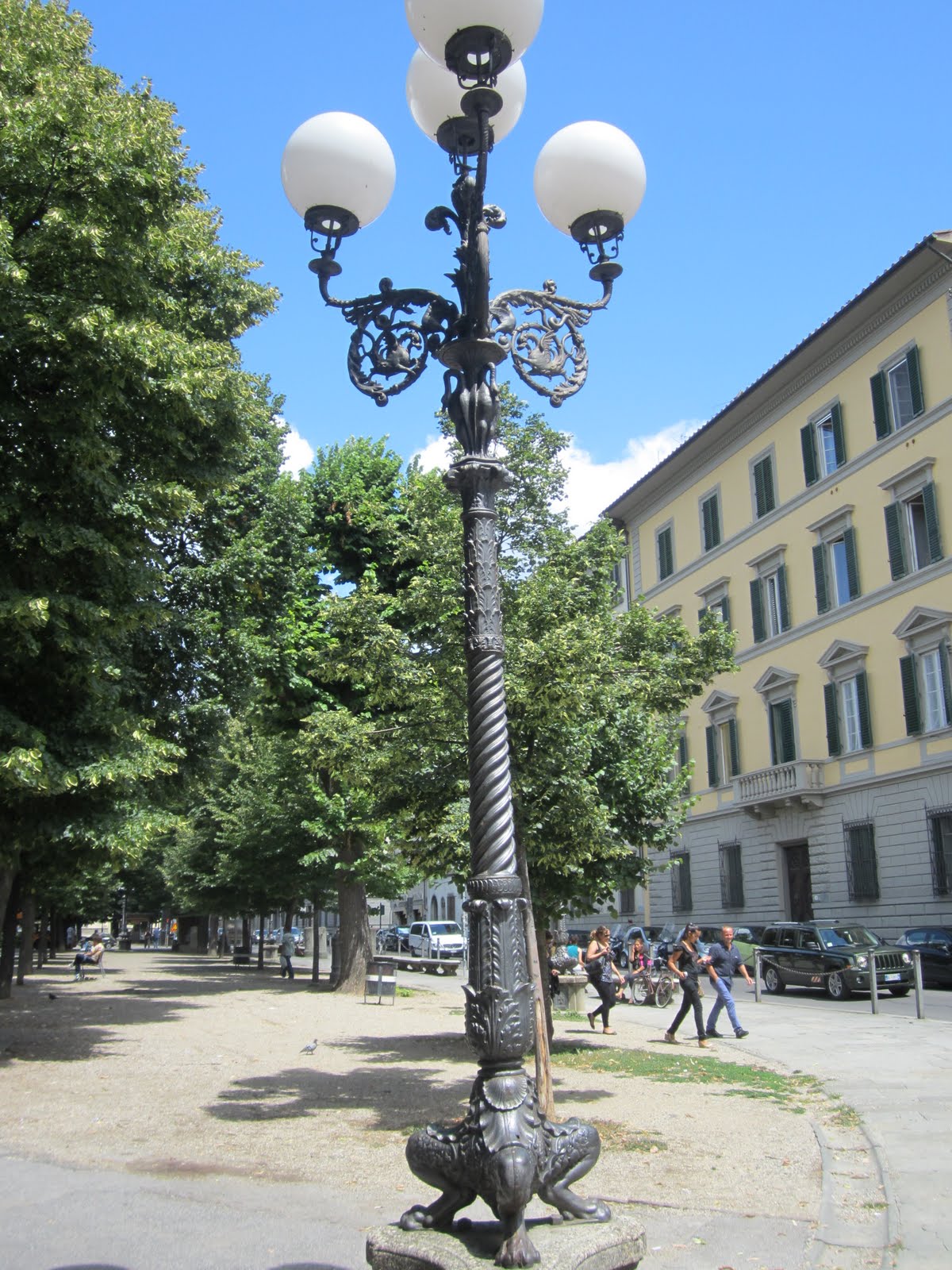
Even the common lamp-posts in Florence had leonine feet!

This print was hanging in our room in Florence..at the hotel Caravaggio, naturally!


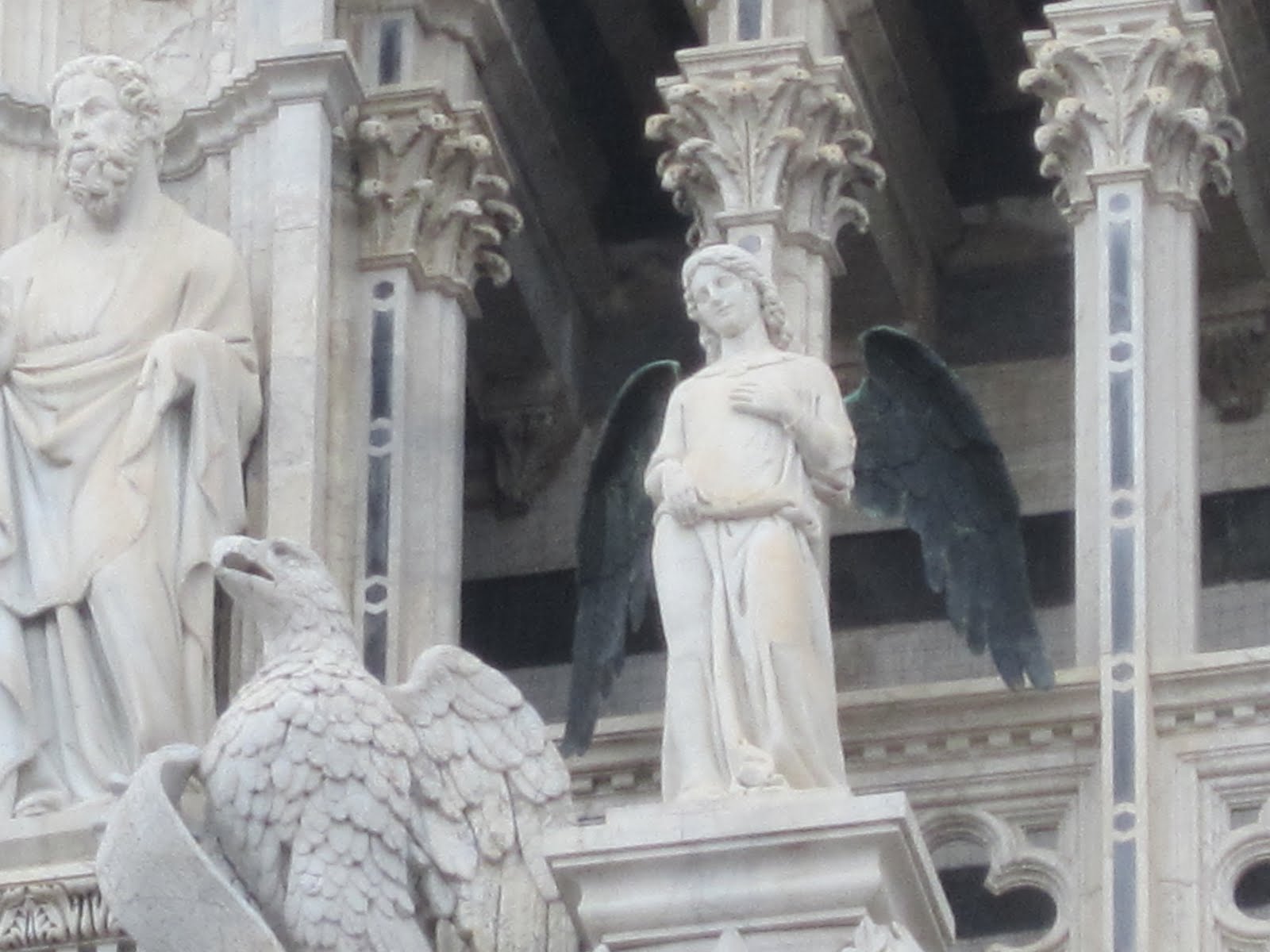
A Cathedral bedecked with all sorts of awesome white scupltures...Closer inspection revealed a lone angel with black wings... Maybe just needs some restoration? It was haunting anyway.


A detail of the famous Duomo in Florence.  My photographs could not possibly convey its magnificence.


From the terrace at the famous Uffizi gallery, near the Accademia (home of the "David"), and which contains the renowned paintings of Botticelli among others.  Just an "artsy" composition to showcase the layers of beauty.


A replica of David in the square next to the Uffizi. (In the sculpture to the right, what is the kneeling man gazing at so intently??)


Modern Art is also highly represented.  Outside of the Pitti Palace and Boboli Gardens in Florence was this startling and unusual piece, which I believe is by sculptor Robert Barni.


Monday, August 8, 2011

Italia--Art is a Way Of Life

Among the famous paintings, sculptures, and architecture, beauty can be found on the most modest facade, in a door or window, on the walls of a parking garage...  Italians are reminded every day of the beauty of artistic creation, and the promise of artistic achievement in any form, any medium.

I worried that Italians might grow complacent to the creative achievement all around them.   On the contrary, as I traveled I found that Italians must internalize this beauty, and incorporate it into a passionate view of the world, whether as musicians or painters, makers of pottery or lace, sculptors or designers, or or even cooks, or lovers.

(My only regret on this trip was being unable to visit the Cinecitta Studios in Rome, hub of the Italian film industry, where Fellini created his masterpieces.)

I will post some of my most prized photographs of the artistic beauty (not to mention the natural beauty) I encountered everywhere.

But first, to illustrate how art plays an important role in even the most everyday of lives, I want to share two examples of simple artists with amazing talent:


This accordion player performed near the Duomo in Sienna. Before I saw this lone figure, I thought a small orchestra had set up to play Vivaldi and Bach in the cul-de-sac.  This man used his entire body to make his instrument come forth with the harmonies and subtleties of a symphony. I had never seen anyone play an instrument, let alone a maligned, "popular", non-orchestral instrument, with such love and passion.


After I took this photograph, I found that street artists with their pastels were a common sight in Florence.  This artist worked his "chalk" into the cobblestones for a soft and harmonious blend of color.  He probably did not earn a lot of money for his effort, which made his devotion to his craft and his considerable talent worthy of reflection: 

Do I write with such care? Do I blend my words and thoughts to such colorful, pleasing effect?

Sunday, August 7, 2011

Michelangelo's David...All In Fun


Blasphemy?  No...just two guys with a camera giving full play to our inner 13-year-olds.

Tomorrow...a more "mature" look at the art around us, from Rome to Florence, from the Vatican to the Uffizi.

Tuesday, June 7, 2011

"Tree Of Life" Has Taken Root in my Mind

Terrence Malick has lobbed a small explosive onto the world's movie screens with the unusual, abstract and strangely affecting film "The Tree of Life".  I had high expectations for this film; I always appreciated Malick's work, his singular vision, and concern with things like the miracle of living and the fear of death. 

It is beautiful and mysterious.  It is filled with the whispered voices of the characters and their entreaties to god, or whatever power controls the universe.  It is an affirmation of the glory of even the smallest aspects of living; it is a shrine to earth's basic elements (sun, air, fire, water and flora);  it is an elegy to childhood and of  learning how to love; it is an attempt to make sense of the finality of death; and, finally, it is a statement that all life is a miracle, whether it be earth's first prehistoric life form, or an average child born, millions of years later, to a seemingly unremarkable family in an almost-forgotten time. 

It is a narrow vision, an artist's vision, not a global one.  Malick presents us with a very specific, somewhat isolated setting, but examines it closely: we are allowed to ponder every human expression, sibling intimacy, natural phenomenon; he forces us to consider such things we typically ignore as the wind blowing through curtains, or the sun shining through the leaves of an old tree.  Depending on one's view of life and afterlife, the film might try one's patience, or wash over one in a dreamy hypnotic way.  It engages the mind first of all.

I admit that I wrestled with its meanings.  I was completely overwhelmed by its beautiful, fertile imagery and constant movement; it is not possible to take it all in in one sitting.  At times awe-inspiring and at other times maddening, I had the feeling that I was part of a historic moment in American film.

It is obvious, early in the film, that there would be no conventional dramatic plot, but a vivid recreation of memory, a yearning to come to grips with ideas that are rarely examined in popular cinema, in a work that is less like a conventional movie than a piece of music, or a collage.  


Malick  stretches the boundaries of movie storytelling. Disparate, seemingly disconnected images slowly come together into focus.  There is a chronology of sorts, which is punctuated by flashbacks and flash-forwards that work visually but mean little until it's all over.  In brief, Brad Pitt and Jessica Chastain are the parents of three boys in a small town near Waco Texas, circa the 1950's.  As the story begins, a telegram announces the death of one of their now-grown sons. 

The eldest surviving brother, Jack (played as an adult by Sean Penn), lives a dreary corporate existence in an urban jungle of sorts.  The movie reflects the workings of his mind, as he reconstructs their boyhood, and family life (the core of the movie), and tries to make some cosmic sense of his brother's death.  He remembers his parents, a stern father who is a force of Nature, and a silent gentle mother who is a force of Grace. 

Malick's thesis is that Nature pleases itself and Grace is selfless, and that we all have to choose to live one way or another.  I wasn't sure I bought into this idea, but I kept thinking about this as the film progressed.

Jack's fleeting thoughts are attempts to reconcile life's meaning, by finding the patterns in nature that surrounded his childhood, patterns similar to the man-made ones in the architecture of his current life.  One senses that Malick is also looking for a meaningful pattern in these boyhood scenes.  He captured amazing images, and spent months assembling them.  Malick's scheme was not readily apparent to me, and I felt I was searching along with him, to understand the reasons why certain shots followed one another, or how their connections created a greater meaning.

Toward the end, in a truly rare bit of surrealism in American film, we seem to be looking at Malick's simple version of an afterlife, on a gray beach in which everyone is reunited, and where Jack's parents are finally ready to give their dead son back to the universe, having declared that love survives everything, even cataclysm and death.  This is presented matter-of-factly, with reverence and without irony.

Two final images, of a bridge, and field of sunflowers, connected for me in a subconscious way, and gave me a thrill of understanding.

"The Tree of Life" left me in a state of deep thought, but did not touch me in a deeply emotional way.  This bothered me, and I put the blame firstly on myself, with an uneasy feeling that I was either not up to its mysteries, or that maybe I was resisting a fundamental belief that permeated the whole film. 

It finally took root, as it were, in my mind, and in retrospect it has sort of blossomed, to a point where I have a deep respect for the achievement, and what Malick was trying to do.  I might not share his philosophy, but "Tree of Life" stands as a worthy visualization of an attitude about life and the unbearable mystery of death.

It occurred to me then that this movie could be a comforting experience to anyone who has lost a loved one, be it human or animal. One of the children asks his mother to tell them a story from before they can remember. "The Tree of Life" is Malick's way of doing that. Who among us has not tried to imagine the impossible, of the time before we were born?  It's as impossible as trying to consider our dying consciousness.  Malick offers us an answer. Maybe we don't believe it, and maybe we find this "unrealistic".  But it is as valid a vision as any fantasy movie, now playing at the local multiplex, that audiences swallow whole.

Malick's approach to building his story is similar to our own manner of recollecting our childhoods, in small snippets of memory coupled with larger segments of intensely emotional life-scenes, and even buried bits from our mind's junk drawer, like a bubble bath, or a dog's face, or a bit of neighborhood mischief, or even the way the grass grew between the cracks in the sidewalk.


In this part of the story, Malick's leisurely method has elicited characterizations that are less acted than lived-in.  Pitt is a revelation, combining the macho expectations of men of that era with a quiet regret of forfeiting his artistic dream.  (His would have been a marvelous portrayal in "Revolutionary Road".)  Chastain is asked to be a saintly presence, and fulfills the role perfectly.  She is convincing as a woman struggling to understand her husband and act as an idealized, positive force for her sons. As young Jack, Hunter McCracken is astonishing in one of the finest, most natural pieces of work by a child performer in many a film.  Sean Penn has a thankless role, and is not entirely convincing as the adult that McCracken will become.  But I had an odd attachment to him. I identified with his existential confusion, his need to make sense of it all.  He says it all in his expression.

I enjoyed Malick's careful depiction of the lazy afternoons filled with play; the closeness of the brothers, who are real kids and not movie brats. I could have done withot the voice-overs...they often acted counter to the meaning conveyed by the images.  This movie sounds beautiful too, with a combination of natural birdsongs, sounds of rushing water, and elusive bits of spoken word, and a music track featuring evocative classical pieces, eerie bells, and original pieces by Alexandre Desplat.

Finally I must mention Malick's audacious rumination on the earth's beginnings, complete with volcanic eruptions, sperm-like movements of celestial bodies, and a quiet moment in which two dinosaurs may have exhibited the first stirrings of altruism.  The sequence carries no explanation, and ends as suddenly as it begins.  In its surprising originality and brilliant graphics, it is a sequence I will hope to study repeatedly in the future.

Is it profound or pretentious? Brilliant or simplistic? I think it is all of these, but most of all it is brilliant, and provocative, and I want to see it again.

I think pop culture is that which comes to its audience, pre-packaged to meet the broadest expectations of the millions who will pay to consume it: Pop culture asks for our approval.  Art, on the other hand, invites us to come to it, consider it, allow our perceptions to be changed by it, but does not require our approval.  It can be threatening to those not equipped or too hurried to meet it on its own terms.  To these, this film will seem meaningless and merely pretentious.  We might expect it to be more complex than it is, or we may be surprised at a simplicity that we may have never considered.  Sometimes what is profound or most beautiful is also most direct and simple, like some poetry. 

"Tree of Life" is a return to a kind of artistic sensibility that seemed to die with Ingmar Bergman.  Terrence Malick, in his desire to visualize the metaphysical, is a worthy successor to this kind of art.

Thursday, May 19, 2011

When Film Critics Are Baffled by Art, and Originality, and "Life"


While reading about this year's Cannes Film Festival, and the violently diverse reception given to some of the new work on display, I reflected on the essays and reviews of one particular film:


"...(It) reached its initial audience slightly in advance of their expectations; acceptance of the film’s radical structure and revolutionary content was slower to come....  While seeing a new use of film, (critics) reacted with responses geared to conventionally shaped films...."


"...The most common complaint of early press reviews ...was its long length and slow pace...."


"...a “crashing bore...”


“...morally pretentious, intellectually obscure, and inordinately long...”


“...a thoroughly uninteresting failure and the most damning demonstration yet of (the Director's) inability to tell a story coherently and with a consistent point of view...”


“...trash masquerading as art....  monumentally unimaginative...the biggest amateur movie of them all...”


No, these are not the critics' comments about Terrence Malick's highly anticipated "Tree of Life", which prompted a round of "boos" along with a chorus of cheers and applause, after its premiere screening at Cannes.

Rather, these are from the original essays and reviews from 1968's "2001: A Space Odyssey", Stanley Kubrick's masterpiece, to which "Tree of Life" has been compared.   Not only that, but these are from critics that I respect, and regard as mentors for my own film criticism; people like Joseph Morgenstern, Andrew Sarris,  Arthur Schlesinger, Jr., and even Pauline Kael.

Kael's dismissal of this ground-breaking work is especially surprising, given her championing of another classic that was highly misunderstood in its initial release: "Bonnie and Clyde" (1967).  Kael's defense of "Bonnie and Clyde" heralded a new openness to cinematic innovation and risk-taking from within the ranks of professional film critics.  She helped save the film from early obscurity, and defined a new way of considering cinematic art.


It is understandable that even astute movie reviewers and critics were lost, when the critera they used to define greatness proved ineffective when analyzing and evaluating a wholly original work like "2001".

Here is a film that entered the consciousness in unfamiliar ways; visually of course but not linearly...it aroused a sense of ambiguity and awe, and was so well-controlled, that sensitive viewers were inspired. 

It unreeled on the screen like poetry on the page.  And, like poetry, it was impervious to a literal interpretation. 

And after the movie haunted viewers, and had a chance to settle; and as the implications of it began to come into focus, the resulting exhilaration---and repeat viewings---guaranteed its classic status.

Film poetry, done well, is rare.

That excitement of connecting to a film's ambiguity, to understand it first of all in your gut, and then later in your head, is an experience I live for at the movies. 

Altman's "Nashville" was like that for me.  And Bergman's "Persona".  David Lynch's "Mulholland Drive".  "The Red Balloon".  "Fellini Satyricon".  Terrence Malick's "Thin Red Line".  Most recently,  "Black Swan" and "Uncle Boonmee". And of course "2001."

I am not in the habit of "reviewing" a movie that I am anxious to see before it's even released. It's not fair to the film, and prevents me from going in with an open mind.  But wow, I am really excited about the release of "Tree of Life".

Let's just say that I am grateful that there's one film artist out there whose work will be unlike the typical plastic Hollywood output.  That there's at least the promise of a summer moviegoing experience that will stimulate the creative juices, and be concerned with matters of heart and mind first and foremost.  Directors like Terrence Malick, even when they fail, deserve support for their originality, wisdom and ambition, from movie-lovers like yours truly!

And, like "2001", there will be the bafflement of professional critics who are not moved by it, or whose criteria to define greatness are rooted in fantasy, or in action that is spelled out and explained...without those, they have nothing at which to Marvel...

I will come back to "Tree of Life" after I screen it in June.  I hope it proves to be half as exhilarating as my anticipation of it. If not...guess I'll have even more to write about, to understand why. 


Saturday, February 19, 2011

Some Favorite Paintings at the Art Institute


If any of you make it to Chicago, we would be proud to have you as our guest to the Art Institute.  As a follow-up to yesterday's photo album of a Chicago Sunday afternoon, here's a look at a few paintings in the Art Institute's collection that captured my imagination, and inspired me to better creative effort.

There is one gallery on the top (third) floor, "European Modern Art, 1900-1950".  These include some of the Impressionists, the Cubists, and Surrealists, artists like Picasso, Dali, Magritte, and others less familiar to me.  I can't wait to keep on as a student of this period, the paintings of which I love on a basic level, which give me a feeling of pleasure and balance.  

As with any form of art, knowing more about it, its construction, its intent, its place in history, can explain why I feel so happy in the company of these artists in this magical and remote gallery of the Art Institute.

FRANZ MARC, "The Bewitched Mill", 1913

A quote next to the painting reads: "Is there a more mysterious idea than to imagine how nature is reflected in the eyes of animals?" Is there a more perfect reason for me to connect with this work?  Notice the deer drinking and a variety of birds. 


GEORGES BRAQUES, "The Little Harbor in Normandy," 1909

I am less familiar with Braque than with Picasso, even though they worked closely together and together established the Cubist style.  I like his work, and this one is especially interesting to me.


PABLO PICASSO, "The Old Guitarist", 1903-04

The Art Institute has a huge collection of Picasso, including a miniature rendering of his famous sculpture in Daley Plaza.  This is a wonderful portrait of a homeless man from Picasso's "blue period".


SALVADOR DALI, "Inventions of the Monsters", 1937

Dali fascinates me with his extremely clear images, that sometimes appear to be melting or bending. His subjects often are brightly lit with long shadows that emphasize their desolated isolation. An unnatural combination of objects and parts of the human anatomy are startling. The pictures always seem to be on the verge of burning. Here is Dali's mysterious interpretation of impending war: the artist and his wife are seated at the table on the left.


RENE MAGRITTE, "Time Transfixed", 1938

This is the painting that inspired me to visit the wonderful third floor gallery. I enjoy the clarity of images that are placed together incongruously, violating the rules of space.  Magritte wanted to "stab" the viewer with the train. 


JOAN MIRO, "Personages With Star", 1933

One of a large collection of Miro, who I find playful..like a child's rendering of Dali.


In later journal entries, I will also offer some favorites by Paul Klee, Juan Gris, and many others...  While my quest for reinvention may not include taking up the brush myself, you never know how enthusiasm, borne of a love of any art form, may manifest itself! For now, I will try to paint with words, and learn enough to teach others some day, perhaps.