Monday, November 15, 2010

Lapping vs. Sucking.... A Monday Journal #1

(Now that I've drawn you in, you might find this short piece to be an amusing relief...)

A study was just published in the online journal of Science that reveals the secret of how cats drink.  After 3 years of observation, inspired by the cat of one of the team of four scientists, it was found that cats are able to suck the liquid through a complex mechanism of gravity and inertia.

A dog actually bends the tongue like a backward J, not forward, as it enters the water bowl, and they use that backward scoop like a ladle to bring liquids into their mouths.  This is repeated in a lapping motion:


After close observation, the cat's tongue also bends like a backward J, but only the soft surface of the tongue touches the surface of the liquid. The rapid movement draws a stream of water up to the cat's mouth, and the cat is able to close off its cheeks and suck in the stream of liquid before it falls back into the bowl:


If my adventure in reinvention allowed me to change my entire way of living, I would become an animal scientist, to observe and solve mysteries of everyday animal behavior.  (On the side, I would write provocative headlines for blogs and other articles.)

Another Communication Revolution? Monday Journal #2

Facebook is launching a new messaging system that will integrate
e-mail, instant messaging and live chat, and will, according to founder Mark Zuckerberg, replace e-mail.

Apparently, e-mail is too slow.  I fear that blogging is the new pony express.

The new system is supposed to integrate several types of on-line communication, so that users have a choice as to how they will receive and respond to text- and web-based messages.

It is daunting.  I had mastered the telephone call, and its sidekick the witty voice mail message.  Fax was meant to save postal time in business transactions.  Then e-mail came along to replace it all, and became an unobtrusive but comprehensive way to stay in touch with scores of people; you could even send pictures! 

Now, in order to be sure that I have covered all my bases in attempting to connect with people, I must send emails, facebook messages, texts, live chats, tweets, web-log comments, and linked-in messages.  Letters in US mail are no longer.  Even phone calls are fewer and further between.

One quote, found today in several on-line publications like Sify, unintentionally betrayed users' impatience with the cumbersome nature of so many types of communication choices now available:

"....Zuckerberg said: 'It's true people are going to be able to have Facebook.com email addresses but this is not email. Email is one way people are going to use this system, but we don't even think it's going to be primary way that people use this system. He said that he did not think there would be an overnight e-mail exodus but that young people have 'suddenly shifted towards real-time communications' and he had to respond...."

Real-time communications was once known as the telephone.  Is that where we're headed?  Has the pendulum has swung the other way?

Perhaps if something is reinvented often enough, it cycles back to its original form? 

"Hereafter" Honestly Moved Me: A Film Review


Clint Eastwood's "Hereafter" treads a delicate line.  It's slow-paced and reflective, it juggles three stories that converge very late in the film, and it's theme is about how we perceive death.  Yet the film is done with such confidence in the material, and treated with just the right touches of sensitivity and objectivity, that it is mesmerizing, visually splendid, and honestly moving.  I really liked it.


Matt Damon's character (George) is smart and lonely. He has psychic ability, so that by grasping the hands of  willing subjects, he can connect with their deceased friends and relatives, and relay messages from the beyond. His brother (Jay Mohr--when did he turn into Jim Belushi?) wants to exploit  George's "gift" for profit, while George wants to leave behind this "burden" which is the reason for his solitude. 

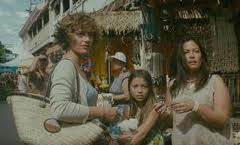
Marie (Cecile de France),  a French journalist and reporter, suffers a near-death during a tsunami, and becomes obsessed with her experience. After receiving a concussion from being swept away by the massive wave, she "sees" visions of lights and human figures, similar to George's "readings".   

Meanwhile, Marcus, a London lad (Frankie and George McLaren) with a drug-addicted mother, loses his twin brother Jason in a shocking street accident, and cannot accept the tragedy.  He embarks on an odyssey to find someone who can communicate with Jason and falls prey to charlatans.


In building these stories about the desperation and loneliness of these survivors, Eastwood and his screenwriter, Peter Morgan, must incorporate supernatural elements into a basically realistic and poetic rumination on death and survival, and keep it believable.  The simplicity of the filmmaking, and the intimacy between characters, allow them to pull this off and draw us in.


Regarding Eastwood's directorial efforts, I am usually hit or miss.  I hated "Unforgiven" and felt "Million Dollar Baby" was manipulative; yet I enjoyed "Bridges of Madison County", feeling it was authentic in atmosphere and emotion.  I guess I appreciate the sentimental Eastwood more than the darker one.  "Hereafter" is both dark and romantic, and is a brilliant directorial effort.  I was glad to see Eastwood stretch his boundaries, to tell a global story with such a sense of beauty, without bloating it.


I will remember the film for a number of compelling scenes from all three of the stories (Damon's segments are most amazing), and for the feelings of melancholy and hope the film left me with at the end.


The tsunami early in the film is an example of movie special effects at their finest.  Not only is the scene shot and edited beautifully, but the effects are clearly meant to serve the story and support a greater theme. The scene works both as spectacle and as material for contemplation.  It is a thrilling segment.


Damon is natural and believable as a man of surprising contradictions (he escapes to a blue-collar existence but indulges in his passion for Dickens) who has a "sixth sense", if you will, but is frequently shown attending to his other senses, like hearing, and taste. 

George listens to audio books, and joins an Italian cooking class.  There, he partners with an infatuated young woman  named Melanie (a wonderful Bryce Dallas Howard), who falls for him. She develops second thoughts after she urges him to do a "reading", in which he learns a painful secret about her past. 

The depiction of their budding romance includes a remarkable sequence during their class, as they take turns blindfolding each other for an exercise in guessing the foods that they feed one another, to discern the flavors and colors.  The instructor plays a beautiful opera in the background, to enhance the sensual experience, as George and Melanie quietly get to know each other.  Their subsequent break puts in motion the action that will eventually draw George into the lives of Marie and Marcus.


Little Marcus is placed in a foster home until his mother responds to treatment, for her addiction and her grief.  He finds a picture of Damon on the internet as he searches for ways to cope with his brother's absence, seeking advice from "spiritualists" and other experts. 

Marie, who enjoyed a position of fulfillment and fame as a reporter, turns her attention to a research book about the moment of death shared by those who survived the experience.  She loses her job, her fame, and her lover, but completes the work that is her passion, and in a nice turn of events, is approached by a publisher. Camille de France is particularly good here, forceful and natural as Marion Cotillard, and as down-to-earth as Juliette Binoche.


In one of the script's contrivances, George, Marcus and Marie find themselves at the same London Book Fair.  They are there for different reasons, and the plot strains to create connections between them.  But as the characters come to terms with their experiences with death, the coincidences slide into place, and we accept them.  For some viewers, the conclusion may feel too tidy, too forgiving of the real pain and horror of death and survival.  For me, the fairly upbeat resolution of each story preserved some mystery and wonder, and gave pause to consider life in a new way, removed from the constant fear of what death will be.


I read a critic's rave on a poster from another film currently in release, that said it made one glad to be alive.  I have not seen that film but I believe it will become a huge hit, because millions of viewers want a barrage of movement and images (to say nothing of the sight of  a man cutting off his own arm).  "Hereafter" will not appeal to that kinetic crowd, and thus will suffer the fate of most art film distributed in the States.  But I urge viewers to give it a chance. I can't assume it will make one glad to be alive, but it may at least provide a feeling of hope of living in less fear of death's unknown.

Thursday, November 11, 2010

Toulouse-Lautrec Painted...A Bassett Hound! (Thursday Art Journal)

~

I made a brief trip to the Art Institute of Chicago today, and relaxed among Renoir's sisters and water lilies, and Henri Toulouse-Lautrec's Moulin Rouge settings.


Later, while searching the web for more information on these works, I was surprised to learn that Toulouse-Lautrec is known for a painting of a Bassett Hound, "Tete de chien courant" (1880 (which translates, sort of incorrectly, as "The head of a foxhound"):


I love the way he captured the little knob on top of its head, which makes me want to gently cup my hand over that vulnerable spot; and the texture of the folds on its face and under its eyes, conveying the somber and mischievous expression.  The ears just look so soft, making a gentle frame around this noble face....


"At The Moulin Rouge", on permanent display at the Art Institute, has always fascinated me. I immediately notice the weirdly-lighted woman in the right foreground, and the different planes of light and action in the background.  I always find something new; and it tells a story in my head.


There's an informative and interesting page on the AIC Website, which described this work.  I have excerpted it below.  (I was not aware that Toulouse-Lautrec lived to be only 37 years old.)


The study of art and literature, music and philosophy, dance and architecture, will provide the education of a lifetime, and deepens my hunger and appreciation for greatness in the art of film. 


... Henri de Toulouse-Lautrec ...frequented the Moulin Rouge, a famous Parisian nightclub named for the red windmill on its roof; here, he depicted many of his friends and favorite entertainers.


In the background, La Goulue, the Moulin Rouge’s reigning dance star, adjusts her red hair while the dwarfish Toulouse-Lautrec and his tall cousin, Gabriel Tapié de Céléyran, walk toward the left. The glum assembly of characters seated around the table includes writer Edouard Dujardin, entertainer La Macarona, photographer Paul Sescau, winemaker Maurice Guibert, and another redhead, perhaps entertainer Jane Avril. The woman with the green face illuminated with artificial light is May Milton, another popular dancer of the day.


...The eerie green light of the interior evokes an unhealthy atmosphere. The artist then added to the visual drama by utilizing different lines, such as the curving silhouette of La Goulue fixing her hair, the collar of Avril’s coat, and the outline of Milton’s sleeve. These lines contrast with the strong diagonals of the banister and the floorboards, which rush forward toward the viewer, enhancing the lively mood of the decidedly worldly setting.

Wednesday, November 10, 2010

Mark Twain Honors Tina Fey--A Wednesday Journal


It is my opinion that Tina Fey has done more to shape the political landscape of the country than any elected official, politician, or pundit.  Her embodiment of then-Vice-Presidential Candidate Sarah Palin scared voters out of their complacency.  Convinced by Fey's dead-on impersonation that there was imminent threat of handing the country over to a genuine buffoon, voters mobilized, and an historic election ensued.  At least for that election cycle, cooler heads prevailed.

It is for that, as much as her multiple-Award-winning work on NBC's "30 Rock", that Tina Fey has recently received the Kennedy Center's Mark Twain Prize for American Humor.

The Ceremony for this 13th Annual Award, which was given to Fey on November 9, will be broadcast on PBS on Sunday, November 14.  Let Award Season Begin!

The Kennedy center recognizes outstanding work in many of the arts, including opera, jazz, theater, ballet, and  modern dance, as well as many types of musical performance.  In 1998 the Center established the Mark Twain Prize for American Humor,  to honor humorists who have had an impact on American society. Twain was known for his observance of culture and for his social commentary.  His quote is an inspiration for the Prize:  "Against the assault of laughter nothing can stand."


In accepting her award, Fey acknowledged her resemblance to Palin, as well as Palin's odd voice, that provided Fey with unforgettable material for hilarious and devastating satire.

Fey is the youngest recipient of this award.  

The proceeds for the ceremonial event support Kennedy Center Programs. 

Other mark Twain honorees inlcude:  Richard Pryor (1998), Jonathan Winters (1999), Carl Reiner (2000), Whoopi Goldberg (2001), Bob Newhart (2002), Lily Tomlin (2003), Lorne Michaels (2004), Steve Martin (2005), Neil Simon (2006), Billy Crystal (2007), George Carlin (2008), and Bill Cosby (2009)