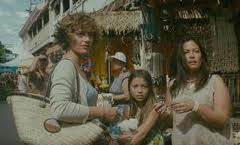
In Woody Allen's 1971 comedy "Bananas", there is a madcap courtroom scene, where the person in the picture below is called to the stand, with the following dialogue:

Attorney: Swear to tell the truth, the whole truth and nothing but the truth?
Witness: l do.
Attorney: Name?
Witness: J Edgar Hoover.
Attorney: Occupation?
Witness: Head of the FBl.
Attorney: Tell the court why you're dressed like this.
Witness: l have many enemies and l rarely go out unless l'm in disguise.
Attorney: Mr Hoover, in your opinion,is Fielding Mellish a threat to the security of the United States?
Witness: Enough to have his phone tapped.
If Dorothi Fox, who was such a hoot as Hoover in "Bananas", could have been persuaded to reprise her role in Clint Eastwood's erratic, ambitious, but muddled bio-pic,"J. Edgar", the result might have been more entertaining.
"J. Edgar" arrived highly anticipated (the blogosphere had practically awarded Leonardo DiCaprio an Oscar before the film's release). This, even though J. Edgar Hoover, the film's true-life subject, a single-minded, controversial, enigmatic, racist, homophobic, paranoid founder of the FBI, has faded out of popular consciousness; younger audiences may be totally unfamiliar with him. There seemed little reason to create a contemporary mainstream film about such an unpleasant figure, unless it could shed some light on modern criminal investigation, or the extent to which the country has evolved (or not) socially or politically.
So, a major Oscar-season prestige movie about Hoover was risky. A lively historic epic, which used Edgar's story to explain the origins of, and draw parallels to, modern concerns about national security, curtailed personal and social rights, and governmental bureaucracy, could have been not only exciting but invaluable. "J. Edgar", sadly, misses opportunities to make these parallels clear.

If any film had the makings of a modern classic, it was "J. Edgar": the story of a controversial American, set during one of our most interesting and tumultuous periods (1930's through 1960's), with impeccable design, produced by a previous Oscar-winner (Brian Grazer), with a complex screenplay by a writer who won an Oscar for an epic, gay-themed biography (Dustin Lance Black), top-tier performers with a high attractiveness factor (DiCaprio, Armie Hammer, Naomi Watts), and guided by the steady hand of an Oscar-winning director (Eastwood).
"J.Edgar" tries to encompass events of four decades to tell the story of how Hoover was selected to start the new Federal Bureau of Investigation; his surreptitious and dangerous blackmail of famous leaders and celebrities by keeping volumes of illegally gathered and incriminating files; and his success in introducing scientific methods to criminal investigation, particularly the tragic kidnapping of Charles Lindbergh's baby in 1932.
And it tries to be a study of the man, and his relationships to key people in his life: his long-time secretary, Helen Gandy, who spurned his early marriage proposal (competently played by Naomi Watts); his powerful and driven mother, a clever and ambitious homophobe (the always fabulous Judi Dench), to whom he was devoted and with whom he lived his whole life; and Clyde Tolson, Hoover's handsome, hand-picked assistant, with whom he shared an intensely close friendship and a rumored love-affair that lasted decades. Tolson is played by Armie Hammer in the movie's hottest, most convincing portrayal.

So why did "J. Edgar" misfire so badly, in the opinion of this writer? Why do I think it might one day be regarded as the Millenials' equivalent of a camp classic on the order of "Valley of the Dolls"?
First of all, one has to question the motives and intentions of those involved in the making of the picture. The studio, Warner Brothers, used to require Hoover's personal approval, to ensure a positive image for the Bureau, before proceeding with big-screen and television treatments of the FBI. Director Eastwood (who has publicly advocated for gay marriage rights), while introducing some of Hoover's more damaging traits, seeks to present a balanced picture, and waters down some of Hoover's heinous behavior that ruined lives. Black may have been tapped to lend legitimacy to the "elephant in the room": Hoover's rumored self-loathing homosexuality.
In short, confusion about the film's direction and purpose is very evident on the screen. After a while, one can only gape at the set pieces, and grasp at whatever dramatic tension one can, or else chuckle in embarrassment... or yawn.
However the idea originated, it feels like a devil's bargain: Eastwood could give the picture a slightly heroic, patriotic American slant, as long as Black could address the gay-martyr angle, but sensitively, "tastefully". Meanwhile, a whole lot of significant and damning history is glossed over, or simply tossed aside.

Second of all, Black's script provides the sand-shifting foundation upon which the whole thing crumbles. What attracted Black to this material in the first place? Unless it was a studio assignment, I can't imagine the writer who memorialized Harvey Milk would be naturally given to write the story of such an unredeemed homophobe. If Black's attempt to humanize Hoover, and provide a cautionary tale about how sexual repression manifests itself in cruelty and paranoia, was well-intended, the result is often misguided soap-opera.
This isn't a screenplay, it's a term-paper. No--it's a research paper still on note cards, which were dropped on the floor, and Black picked them up in the wrong order: the constant shifting back and forth between time periods is distracting, with no moment of clarity, of insight. The technique by which the title character dictates his life story, while the film flashes back to portray his anecdotes, was successful in "Milk", "Amadeus" and many others. In them, the dictation scenes are used as an anchor, with a consistent listener, to which the film could return to breathe, before going on to the next sequence. Here, even the guys taking dictation change from time to time with no explanation.
Toward the end, when an aging Tolson chides Hoover for misrepresenting his whole life, and we discover that a lot of what we just witnessed was not true, the viewer gets the impression not that Hoover was the secretive, dishonest and dangerous character that he was, but that he merely over-exaggerated his reputation in order to sell more comic books.
Clearly, Black has no feeling for the historic events involved, and he fails to find their relevance. Black demonstrates his true strength in the highly-charged interchanges between his characters, where emotions can be expressed, which are at turns compelling, dramatic, unnerving, erotic. If "J. Edgar" were to narrow its focus, move chronologically across many events, or just concentrate on the relationship with Tolson, or the mother-son thing, or the Lindbergh kidnapping as the most significant event in Hoover's professional life, "J. Edgar" would have been more powerful, more worthy of consideration as a serious undertaking.

The third misfire in this film, I am afraid, is in the casting of DiCaprio as Hoover. Much has been made of his portrayal that spans across decades, and the painstaking aging process (discussed below). From my first glimpse of the early trailers, I knew that DiCaprio, whose best roles have been character parts or romantic heroes, was badly miscast. This could be the worst piece of miscasting of the year. DiCaprio works so damn hard, and he isn't terrible, just---wrong, and there wasn't one moment where I was not aware that this is a boyish actor, struggling to convince us that he is this bulldog of an historic figure. It was as if a youngster dressed up in his father's--no, his grandfather's--wardrobe, to do some play-acting.

More than the failed look, though, is DiCaprio's voice. He tries valiantly to mimic Hoover's clipped vocal inflections, and unusual accent, but Leo is cursed with a laid-back adolescent's diction. It drips from his consonants and bleeds through in his long, serious monologues. Even if the movie had a better script, the film's success lies in our ability to accept the actor as Hoover. It doesn't matter if he "played" it well...Meryl Streep could have played it well too, but she would not have been any more convincing. (DiCaprio's eyebrows, his tool for expressing just about everything, get a great workout here.)

The fourth misstep might be Eastwood himself. A director with a firmer touch would have had better control of his casting, the pacing, and the look of the film. He might have insisted that the screenplay take more time in some areas, less time in others, and clarify its history. Although the set design and costuming are terrific, the film is drained of all color, and different periods of time all have the same dreary look, which adds to the confusion. Eastwood's palate, aided by his long-time cinematographer, is that of an ashtray having been emptied on a soiled diaper.
Eastwood knows how to stage his actors, and shows some surprising sensitivity in his scenes with DiCaprio and Watts, or Dench's evil admonishments, or the building passion between Hammer and DiCaprio. But some scenes are head-shaking in their misguidedness.
Hoover's reaction to his mother's death, by donning her dress and speaking her words, is a half-assed speculation meant to address rumors of Hoover's cross-dressing. Mrs. Bates must be smiling.
There is much innuendo in the Hoover-Tolson scenes, and Hammer, with his smooth voice and handsome, sincere openness, makes them work. The climactic glass-shattering altercation between Hoover and Tolson, in which jealousies come to a head, and Tolson plants a kiss on the shocked but yielding Hoover's bloodied mouth, is a sexually provocative gay moment. But the film's failure to pursue this astonishing plot development brings us back to an unfortunate, pre-"Brokeback" era in Hollywood film.
This scene, highly discussed, is one of the best scenes in the film, but it hardly belongs in this film about Hoover. Did anyone think that, perhaps, a fiction film, starring DiCaprio and Hammer, as two attractive men who discover their mutual passion and love, could have come off just as well, if not better?
Finally, I felt that to anyone who didn't know much about Hoover before the film, "J. Edgar" would leave one with an uncomfortably muddled, even undeservedly positive view of the man. The film plays like a greatest-hits of crime-scene accomplishments, achieved by a tragic figure who might have been a better person if he were able to consummate his love. The tone was, in the end, heroic, I think, and inappropriately so. Eastwood, who lived through the Hoover era, surprises me; maybe it's a tacit gratitude for a Dirty Harry role model, someone who breaks the rules to enforce the rules?
The fifth and biggest blunder is also the hardest to understand. This movie practically drowns in makeup, and bad impersonations. Actors portraying Robert Kennedy and Richard Nixon are especially bad. There was no reason, really to include them as screen characters, and so they exist as symbols, meant to elicit an emotional reaction from viewers from a certain era, but without any context of their own.
And the makeup....Tons of it. DiCaprio looks like Jack Nicholson as Jimmy Hoffa through about half the film, another reason why, if an actor needs to be so disguised to play a part, then the part must be a bad fit. Armie Hammer comes off the worst, with latex slathering all over his head and face, that takes away any trace of his actual features. Tolson would have been about 65 in these scenes, but Hammer looks well past 90, and he moves with a tremor; the film makes him look like Henry Fonda AND Katharine Hepburn in "On Golden Pond". Naomi watts, makeup or no, inhabits her role very well, but she is unrecognizable for most of it; could they not just hire some older performers? Judi Dench---well, if anything, they made her look a year or two younger in some scenes.
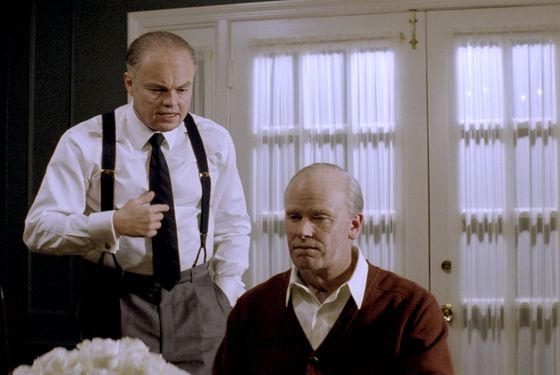
As I sat through "J. Edgar", and did my best to get absorbed in the "love story" and make heads or tails out of the film's portrayal of history, I wondered how an average viewer, sincerely interested in the subject matter, would come away from the film. I suspect the word of mouth has not been good. I hate to add to that, but I have to say that "J. Edgar" was one of the year's big disappointments.